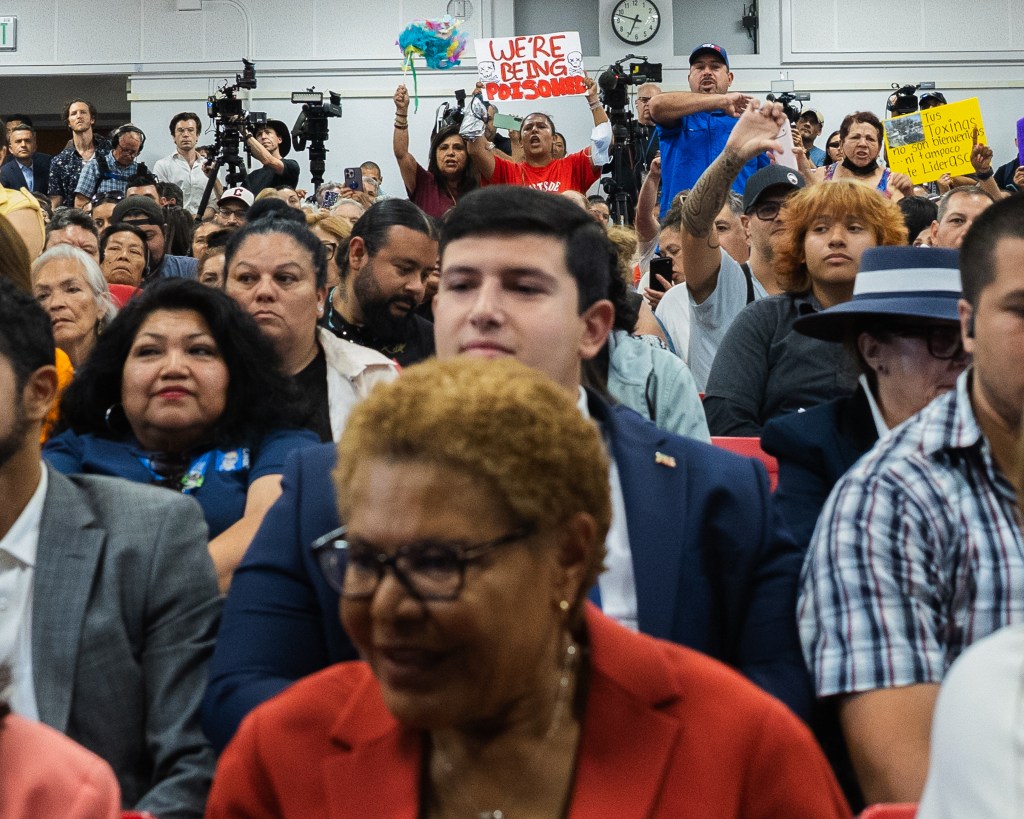
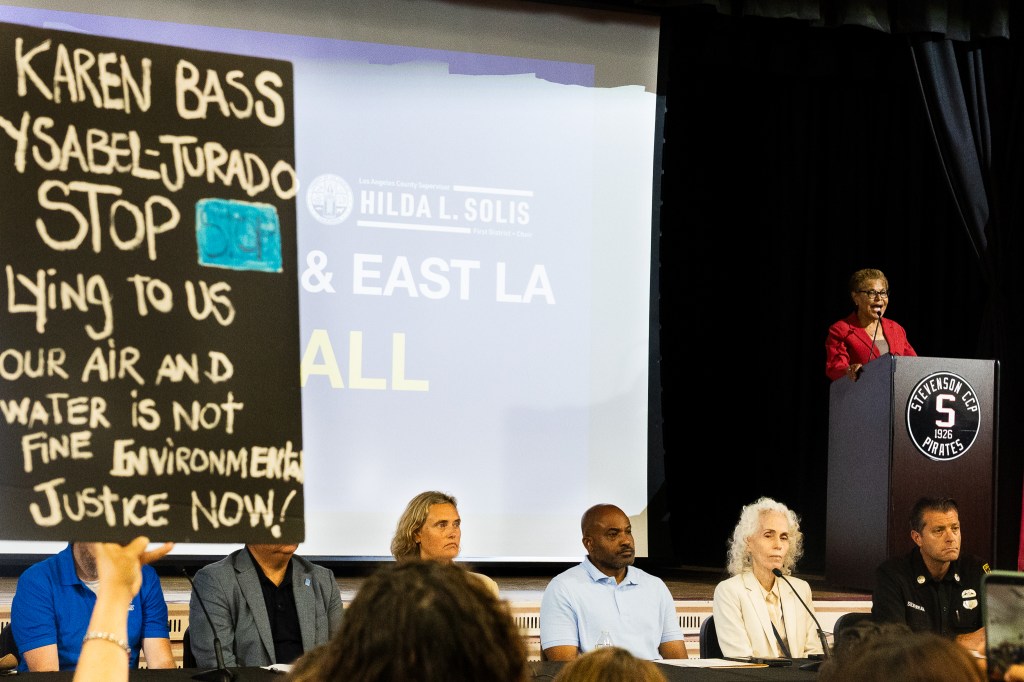
A woman raises a sign after Mayor Karen Bass (center) entered the auditorium of Robert Stevenson Middle School in Los Angeles on Thursday, July 9, 2026. Bass called for a town hall after an environmental crisis occurred in Boyle Heights. (Kayjel Mairena)
By Kayjel Mairena
LOS ANGELES —A contentious town hall in Boyle Heights on Thursday ended with numerous residents repeatedly heckling city officials and representatives from Lineage Logistics. They demanded the closure of a cold-storage warehouse responsible for an environmental crisis that hospitalized multiple people and forced others to evacuate their homes.
“We’re here because we want Lineage out,” said Antonieta Garcia, an East Los Angeles resident. “This is the last straw. We need them out.”
Make a one-time donation
Make a monthly donation
Make a yearly donation
Choose an amount
Or enter a custom amount
Your contribution is appreciated. Your one-time contribution is appreciated. Donations are always welcome, there is no paywall.
Your contribution is appreciated. Your one-time contribution is appreciated. Donations are always welcome, there is no paywall.
Your contribution is appreciated. Your one-time contribution is appreciated. Donations are always welcome, there is no paywall.
A June 17 fire spread from solar panels on top of Lineage, Inc.’s warehouse located in the 1400 block of South Los Palos street. The blaze engulfed the building’s refrigeration system and other industrial equipment. For eight days, firefighters fought the flames round-the-clock, collaborating with various agencies including the Emergency Management Department, California Air Resource Board and CalOes Fire to end the crisis.
Thick, heavy black smoke hovered over Boyle Heights and neighboring cities. Afterwards, the stench of millions of pounds of spoiled food from inside the building seeped into the nearby area. The stench and air quality continues to concern many living in Boyle Heights, East Los Angeles and surrounding areas.
Garcia rushed into the town hall with a large protest group before the meeting started. While hundreds of people waited in the searing heat, being turned away, she charged into the auditorium of Robert Stevenson Middle School to speak her mind.
She said she went to the town hall for her daughter whose chronic respiratory issues worsened after the Lineage Logistics cold-storage warehouse caught fire.
Los Angeles Mayor Karen Bass declared a local emergency on June 20 for extra resources. In the declaration, Councilmember Ysabel Jurado, who represents Boyle Heights, stated “residents have lived through days of smoke, shelter-in-place orders, disruptions to daily life, and ongoing questions about what this means for their health and well-being.”
A “disgusting,” lingering smell halted the local economy and caused a rise in respiratory illnesses, according to Garcia.
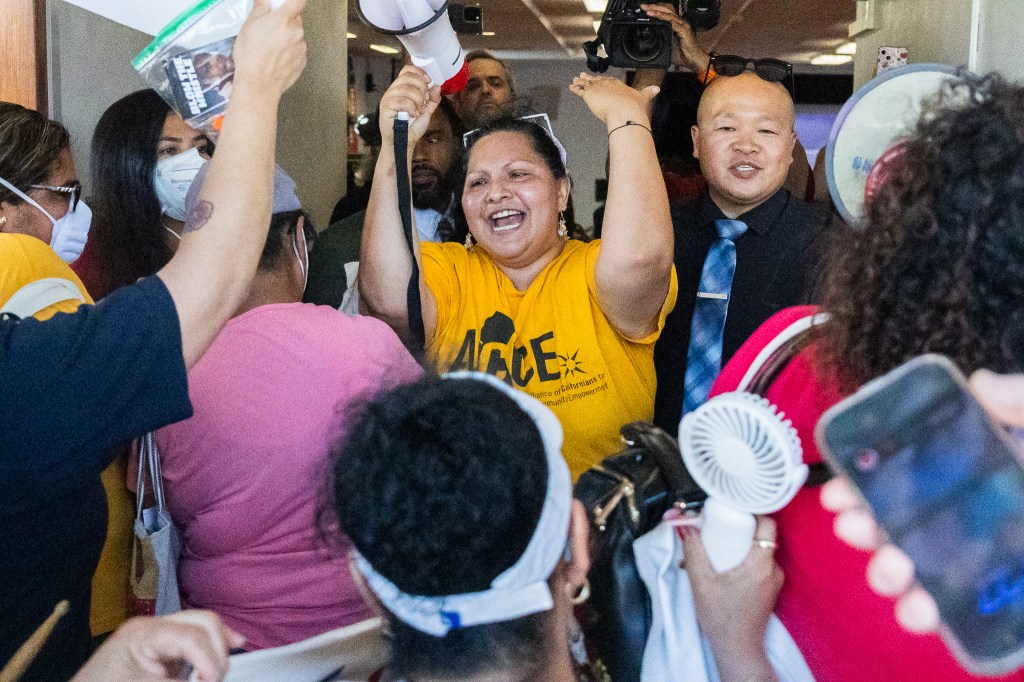
“The community is waking up,” she said. “We all need to be united, and do it together to get Lineage out, because they don’t want to. It looks like these politicians don’t want to get it out.”
Garcia said rushing into the town hall made her feel powerful and heard. As her protest group yelled, people who were sitting cheered them on.
Multiple people in the crowd accused Bass of overlooking environmental dangers posed by Lineage, citing a monetary donation from the company’s co-founder Kevin Marchetti. In 2025, Marchetti donated $1,800 to the mayor’s campaign, according to the Los Angeles City Ethics Commission.
Days after the meeting LA Material reported Yusef Robb, a longtime unofficial advisor to Bass, had been working as a communication consultant for Lineage. According to LA Material, Robb’s services began there several days after the fire broke out.
The majority of residents showed a united front and a strong distrust of city officials at the town hall.
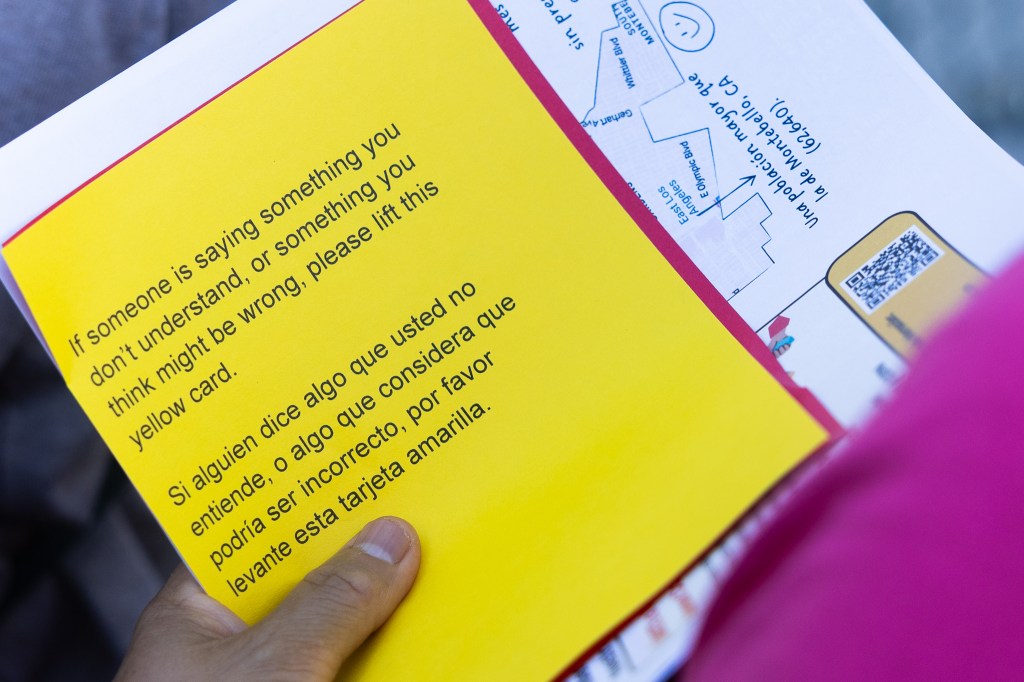
A woman holds red and yellow foul cards, inspired by the FIFA World Cup, at a town hall at Robert Stevenson Middle School in Los Angeles on Thursday, July 9, 2026.The cards were intended to be used whenever they believed city officials were being insincere. (Kayjel Mairena)
Yellow and red foul cards were raised whenever the crowd believed they heard an insincere response from a local official. Consistently, people shouted “liar” at whoever was speaking while waving a piece of colored paper.
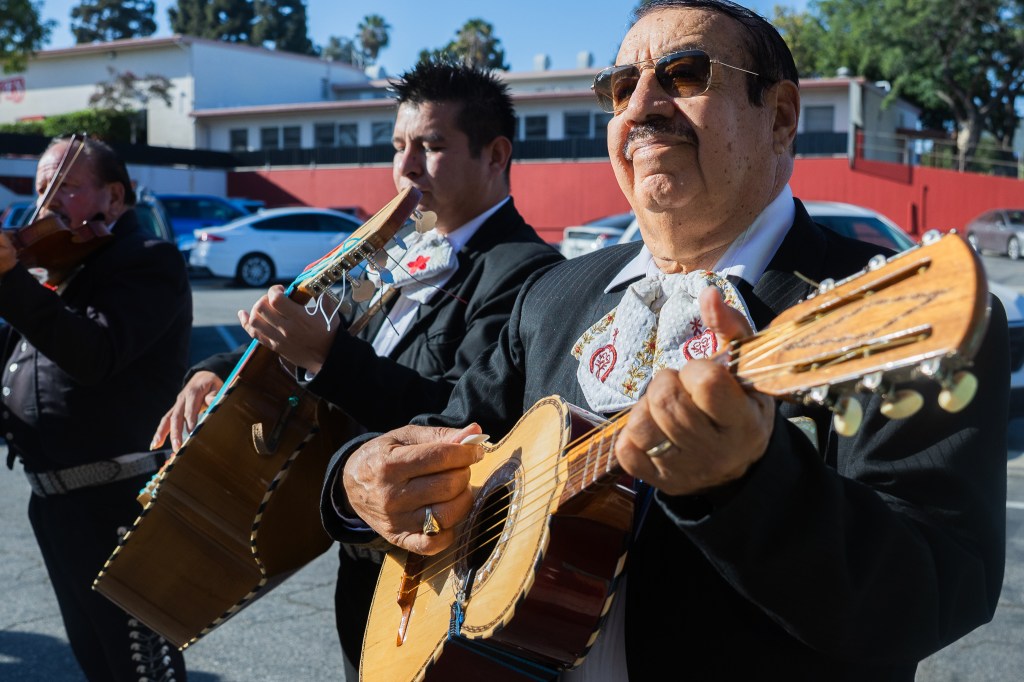
Tensions were high before the meeting had even started. People were outraged by the mariachis that the Mayor’s Office hired to perform while people waited in line. They played the famous Mexican folk song “Cielito Lindo,” right up to the chorus. As the mariachis belted in Spanish, “¡Ay! ¡Ay! ¡Ay! Sing, don’t cry,” a man interrupted them and said it wasn’t appropriate — they weren’t here to celebrate, he said.
Historically, city officials have marginalized the residents of Boyle Heights. The now-majority Latino neighborhood originated through a now-illegal practice known as redlining, where people were denied mortgages and loans based on their race or ethnicity. The discriminatory practice led to the creation of secluded minority neighborhoods in industrial regions spread throughout LA.
Jose Cervantes (right), a mariachi and Boyle Heights resident, performs in the parking lot of Robert Stevenson Middle School in Los Angeles on Thursday, July 9, 2026, before a town hall meeting. (Kayjel Mairena)
Several street lamps throughout Boyle Heights have signs posted on them, sharing the neighborhood’s long, oppressed history. The signage details how Jewish families established themselves in the area, and were later targeted for harassment by the police. It notes how multiple marginalized groups such as Black people, Japanese immigrants, and Chicanos later found refuge in the community, and used their organizational skills to implement social change within the region. The once overlooked and underserved pocket of LA is now a celebrated cultural landmark but most residents are well aware of their neighborhood’s past and governmental role in their poor material conditions.
Four freeway junctions and six rail yards traverse Boyle Heights and the East LA neighborhood. According to the California Air Resource Board, both communities are surrounded by numerous blue-collar industries, have high rates of poverty and are located in close proximity to pollution sources.
At the meeting, a public commenter asked city officials and the Lineage representatives what steps are being taken to mitigate another environmental crisis and how future companies will be held accountable.
According to Lineage’s Global Chief Operations Officer Jeffrey Rivera, the company ordered an evaluation of the solar panels at their other buildings around the world in the aftermath of the fire to mitigate another incident.
Executive Director of LA Civil Rights Capri Maddox replied to the public commenter saying moving forward the city intends to find other problem locations before another incident occurs, knowing these facilities are often located in “some of our most underserved and vulnerable communities.”
If people want to hold air polluters accountable, they must call 1-800-CUT-SMOG, every single day. Without repeatedly calling and filing a complaint, the agency is “not able to issue a public nuisance violation,” said Wayne Nastri, Executive Officer of South Coast Air Quality Management, to the crowd.
Nastri’s response drew angry reactions from both the residents and Bass. She described the statute as “not okay,” and when Nastri tried responding, she raised her hand, shook her head and silenced him.
At the beginning of the meeting, Rivera said the residents aren’t the only people who are disappointed about the fire. He said, “I know how upset you are. We’re upset. Our building burned down.”
The median household income in Boyle Heights is $51,389, according to a demographic profile from the department of LA City Planning. Lineage’s SEC filings reveal that Rivera made $4,152,361 in total compensation last year. The median annual total compensation of Lineage employees is $56,102.
According to Rivera, 80 out of 120 workers have been relocated to jobs in other buildings. The other 40 are waiting on job placement, Rivera added.
Rivera, the lineage warehouse workers and nearby residents are all facing different challenges, stemming from the fire. However, the total damage and disruption to daily life will vary depending on factors such as finances.
Rivera mentioned that the clean-up process started on Monday, and that Lineage intends to finish in under 45 days. The Boyle Heights Response & Recovery website stated that there are no air quality concerns and that 440 tons of waste has been removed. The page also claims that Lineage has contributed $2.5 million to the community, in addition to providing housing vouchers, utility support and cash assistance.
A statement released on July 9 from Lineage, Inc. said Rivera “recognize[s] the profound impact this fire has had on our neighbors in Boyle Heights and East Los Angeles. It continues, saying “our expanded support today is the direct result of listening to nearby residents and community leaders and acting on what we have heard. We have been here throughout this situation, we will continue to be here, and we will keep listening, for as long as this recovery requires.”
However, throughout the meeting, multiple hecklers questioned the sincerity of the city’s response to the ongoing crisis. They raised concerns about the lack of shelters, available resources and clarity surrounding their well-being.
A public commenter said he’d speak on the behalf of the Spanish speakers because the mayor’s team didn’t provide them with directions on how to participate in public comment.
He said, “No one has approached our homes to ask what we need, are you okay. Nobody worries. On the TV, they say they keep giving things out but it never reaches the community. Nobody worries about us. You’re only on tv to publicize yourself because you need our vote and our support, but really, now that we need them they’re not with us.
“They’ve abandoned us. If we were Beverly Hills, if we were some other city, we’d receive an adequate response but because we’re Latino, they’ve discriminated against us.”
Residents wiped sweat from their faces, shouted over speakers and repeatedly interrupted officials with chants of “liar.” They said they’d come for answers about the condition of their neighborhood, and city officials instead played childhood games with them.
Towards the end, residents walked out of the town hall saying they felt unheard. Boyle Heights Neighborhood Councilmember Tomasa Martinez said city officials “ignored” and “mocked” the audience.
When Bass lost control of the room, she’d asked people to clap if they heard her, eventually regaining the audience’s attention by drowning out the sound of people yelling at her. At one point, the crowd kept interrupting her to which she replied, “We’re going to have a contest as to who can yell the loudest.”
Some people were angry that they were turned away from the meeting. A promoted resource fair was tucked and hidden inside the middle school hallway, angering others: residents struggled to access it. Many were unaware that there were resources available on location.
“I feel bothered and frustrated because they didn’t give a solution, and the community wants them (Lineage) to leave, wants them to withdraw, get away from here. Don’t return to contaminate our community — not Boyle Heights, not East LA, not another one.
Once city officials limited the number of speakers, the room began to thin out. One by one, people left, leaving behind rows of empty seats and a long line of people waiting for a chance to speak. When the moderator tried ending the town hall, the audience shouted. Eventually, both sides agreed to let three more people voice their concern.
A cancer survivor who says his disease was brought on by Boyle Height’s polluted environment closed the town hall. He said his neighborhood block consists of 19 houses, and he’s aware of 13 people from the area who have died from malignancy or were diagnosed.
City officials ended the town hall after 8 p.m. but residents weren’t done speaking to them. Multiple people followed Bass to her car, surrounding the passenger side doors. A woman blocked the front of her vehicle, and was pushed by a member of the mayor’s team. After the car sped away, the woman began hyperventilating, and an ambulance was called.
“It’s a shame that our elected officials, our city, state and county agencies have compromised their integrity with our communities,” the last public commenter said. “It’s a shame, and we’re going to be judging you from here forward as to what you do.”
“We’re asking for some sort of help to get this community back to health. Just because you can walk down the street and don’t see a dead body, or your arm hasn’t fallen off, does not mean that our health is okay and we’re not in danger.”
Kayjel Mairena is a talented multimedia journalist and we are very proud to have him contribute to the Ten Four. You can support his work via Venmo here
Make a one-time donation
Make a monthly donation
Make a yearly donation
Choose an amount
Or enter a custom amount
Your contribution is appreciated. Your one-time contribution is appreciated. Donations are always welcome, there is no paywall.
Your contribution is appreciated. Your one-time contribution is appreciated. Donations are always welcome, there is no paywall.
Your contribution is appreciated. Your one-time contribution is appreciated. Donations are always welcome, there is no paywall.


Leave a Reply