
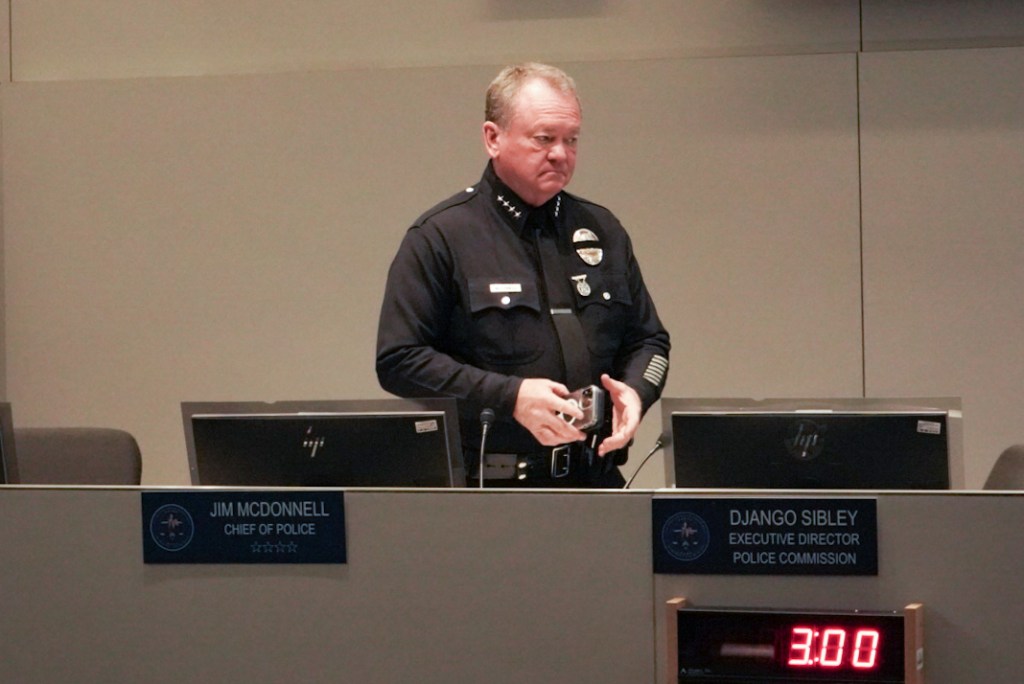
Los Angeles Chief of Police Jim McDonnell attends a Board of Police Commissioners meeting on June 17, 2025 at LAPD Headquarters (Sean Beckner-Carmitchel)
By Kayjel J. Mairena
Kayjel J Mairena is a multimedia journalist who is currently News Editor at the Santa Monica Corsair. His venmo is here.
LOS ANGELES — Los Angeles police can legally stop drivers for small violations and question them for unrelated crimes. Recent data shows Black and Latino drivers continue to be disproportionately affected by the practice. Los Angeles City Council President Marqueece Harris-Dawson revealed that he himself has been pulled over four times, and had even missed a meeting that week because of it.
Make a one-time donation
Make a monthly donation
Make a yearly donation
Choose an amount
Or enter a custom amount
Your contribution is appreciated. Your one-time contribution is appreciated. Donations are always welcome, there is no paywall.
Your contribution is appreciated. Your one-time contribution is appreciated. Donations are always welcome, there is no paywall.
Your contribution is appreciated. Your one-time contribution is appreciated. Donations are always welcome, there is no paywall.
DonateDonate monthlyDonate yearlyBy the end of a March 6 committee meeting, a presentation showed that LAPD still pulls over Black men at a rate almost three times more often than white men. Council members requested LAPD’s Board of Police Commissioners update the department’s pretextual stop policy to address racial disparities in policing. During the session, the committees discussed a newly released data brief from Catalyst California, a racial equality advocacy group.The meeting was held jointly by an ad hoc Committee on Unarmed Crisis Prevention, Intervention, and Community Services as well as City Council’s Transportation Committee.
Catalyst California analyzed the LAPD’s officer-initiated traffic stops from 2019 to 2025, using records from the state Racial & Identity Profiling Act of 2015, which requires law enforcement to report all pedestrian and vehicular stops to the Attorney General. Their presentation and data brief stated that despite a 2022 LAPD policy change that limited pretextual stops, the practice remains a racially biased and ineffective safety strategy. 31% of pretextual stops in the city are on Black residents despite only accounting for eight percent of the population.
“When Black Angelenos make up 31% of the stops, but only 8% of the population, the evidence is clear: this practice is the LAPD’s version of the NYPD’s Stop and Frisk,” said David Turner III, an assistant professor at UCLA during public comment. Turner has a doctoral degree in social and cultural studies in education.
A pretextual stop is when law enforcement stops a vehicle for a minor violation as a pretext to investigate unrelated criminal activity. LAPD adopted a policy in 2022 requiring officers to only make pretextual stops based on “articulable information” regarding a serious crime. The policy also states officers must also state the reason for the stop into their body cameras.
According to the 2022 policy, LAPD officers cannot make pretextual stops “based on a mere hunch or on generalized characteristics such as a person’s race, gender, age, homeless circumstance, or presence in a high-crime location.” However, data of LAPD’s stops show wide disparities based on some of those same characteristics.
Since 2022, LAPD officers conducted self-reported searches on Black and Latino people at a higher rate than White people, between 1.9 and 2.7 times and 1.4 and 2.2 times, respectively, according to the data brief. In LA, Black and Latino people make up around 55% of the population, but they comprised approximately 86% of recorded pretextual stops, according to a 2026 Chief Legislative Analyst report. Almost half of these stops occurred within Council Districts 8, 9, 14 and 15.
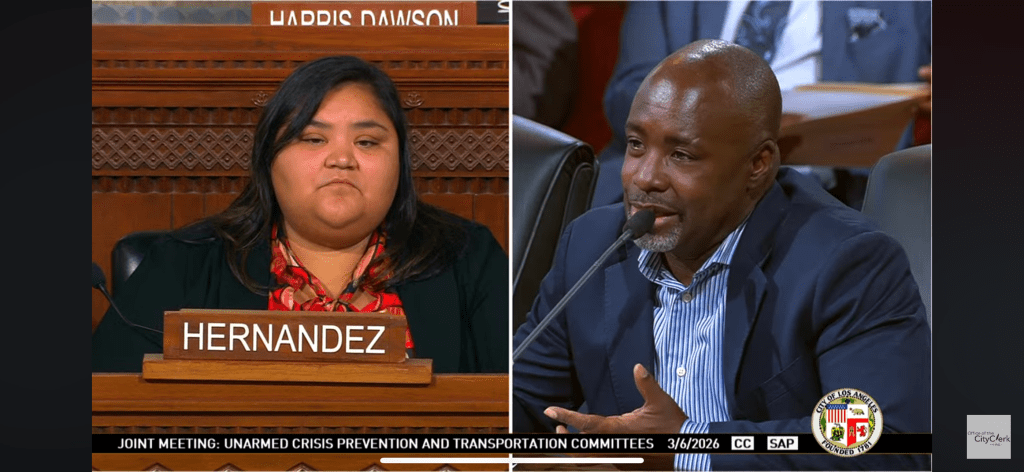
Marqueece Harris-Dawson addresses the committee meeting on March 6, 2025 at Los Angeles City Hall. Left, Councilmember Eunisses Hernandez. Right, Council President Marqueece Harris-Dawson. (Los Angeles City Clerk / YouTube)
“As a member of this council, driving in a government issued vehicle with an E-plate, I’ve been stopped four times, as recently as this Wednesday,” said Harris-Dawson during a speech at the meeting. “It was as traumatic on Wednesday as it was when I was 16.”
During the joint session, LAPD Captain Shannon White from the Strategic Planning & Policies Division defined articulable information as what an officer knows at the time based on departmental records, like wanted posters, or their knowledge of the area.
According to White, officers can legally make pretext stops for a wide variety of reasons because department policy does not clearly define what articulable information is.
“We’ve seen some conflation between the idea that pretext stops solely focus on moving violations, whereas the act of pretext stops themselves can use the entirety of the California vehicle code as the basis for initiating the stop,” White said at the meeting. “Again, it goes back to the officer’s mindset.”
Harris-Dawson oversees Council District 8, which includes neighborhoods in South LA like Chesterfield Square, Crenshaw and West Adams. He said at the meeting that when the LAPD officers conducted a pretextual stop on him, they asked him to identify himself, and followed up by questioning whether he was on parole, what his job was and even how he obtained a city vehicle.
Being stopped by law enforcement is a scenario many Americans are taught to prepare for after getting a vehicle, Harris-Dawson said. Drivers are told “to be compliant, to not make eye contact, to keep your hands on the steering wheel, to not raise your voice, to not make any sudden movements,” he added.
“One small thing in that encounter can result in serious injury or death,” he said.
If a person is stopped, officers are required to obtain consent before a search. There are four levels of consent ranging from highest discretion to lowest discretion, depending on how much information the officer justifies the stop with, according to the data brief.
Officers can conduct “highest discretion” searches based solely on consent, while “low discretion” searches are done without consent and are based on drivers’ parole or probation status. Since 2022, “highest” and “low” discretion self-reported searches have had an above 91% failure rate, the data brief stated.
The effectiveness of pretextual stops is measured by how often evidence is found during a search, known as the discovery rate, according to the data brief. The third least successful search is high discretion searches with a success rate ranging from 8 to 22%, or a 78 to 92% failure rate, the data brief stated.
Lowest discretion consent searches yield the highest amount of evidence, with a discovery rate of 41 to 55%. But these often occur in situations where there’s a higher likelihood of a significant violation, like during an arrest or while impounding a car or executing a search warrant, the data brief stated.
People have the right to deny being searched. But sometimes it’s not obvious. “Oftentimes it doesn’t feel like it’s a choice,” for Black or Brown Angelenos, Councilmember Eunisses Hernandez said at the meeting.
In 2020, LAPD’s Office of the Inspector General told the Board of Police Commissioners that they had concerns about officer compliance with policies and procedures in a small number of pretextual stop cases, including over whether officers properly received affirmative, voluntary consent.
The OIG review of 2019 stops stated that in about 7% of officer-marked consent searches, the person being stopped could not be heard on bodycam giving consent or it was acquired after the officers completed at least one search. In some instances, the officer’s language “may have been interpreted to mean that the search was not, in fact, voluntary,” according to OIG.
“Other issues included concerns about officers moving or pulling up the clothes of people stopped, taking photos while a person was handcuffed, timely activation of body-worn and in-car video recordings and the accurate completion of FI cards,” the OIG review stated.
Other issues included concerns about officers moving or pulling up the clothes of people stopped, taking photos while a person was handcuffed, timely activation of body-worn and in-car video recordings, and the accurate completion of [Field Interview] cards.
During public comment on March 6, critics of pretextual stops said the practice erodes public trust, contributes to overpolicing and takes money away from necessary resources and infrastructure.
“The LAPD raised me, so my experience is going to be different from those that you heard. They clothed me, they fed me, they nursed me. I actually pinned the badge on my parent, who’s still in uniform today, ” said LiQuan Hunt, a worker at the Social Justice Institute, during public comment.
“Having been a direct product of pretextual stops, being stopped 19 different times in the city of Los Angeles in the past 17 months, I can tell you first hand, those blessings, those opportunities, my father, those accolades, hasn’t stopped me from experiencing the exact same things that those who look like me have experienced, and that’s troubling,” said Hunt during public comment.
At the end of the meeting, the two committees voted 13-0 to pass the motion requesting the LAPD Board of Commissioners amend their pretextual stop policy. The motion had five recommendations, and Councilmember Bob Blumenfield, the co-chair of the Ad Hoc Committee on Unarmed Crisis Prevention, added a sixth upholding LAPD’s ability to conduct some pretextual stops:
- Prohibit all pretextual stops and detentions that result from pretextual stops of motorists or cyclists except where the violation poses an imminent safety risk.
- Prohibit consent based searches of persons, vehicles or personal effects during pretextual stops. This prohibition does not apply to searches by a valid warrant, probable cause or other legal justification
- Ensure compliance with California Assembly Bill 2773 by requiring officers to clearly articulate the reason for the stop on body worn video before commencing any questioning. Officers should thoroughly record both visibly and audibly any reasonable suspicion that develops after the initial stop.
- Ensure proper compliance and the implementation of AB 2147 to prevent racial bias in stops of pedestrians.
- Report back with the assistance of the city attorney with the process and the necessary steps to implement a mail based notification system that would allow certain traffic violations, allowing vehicles to receive a violation by mail instead of performing an officer initiated stop.
- Affirm LAPD’s authority to conduct stops for traffic violations that endanger public safety and for reasonable and articulable suspicion of crimes.
“Continued dialogue around this only perpetuates an issue that we all know is very obvious from the data. But as someone who respects what the LAPD does, who understands what they do, I’ll be remiss not to hold them accountable for the experiences that myself and my peers have spoken to you. My request is to do better,” Hunt said.
 LA Ten Four
Leave a comment