
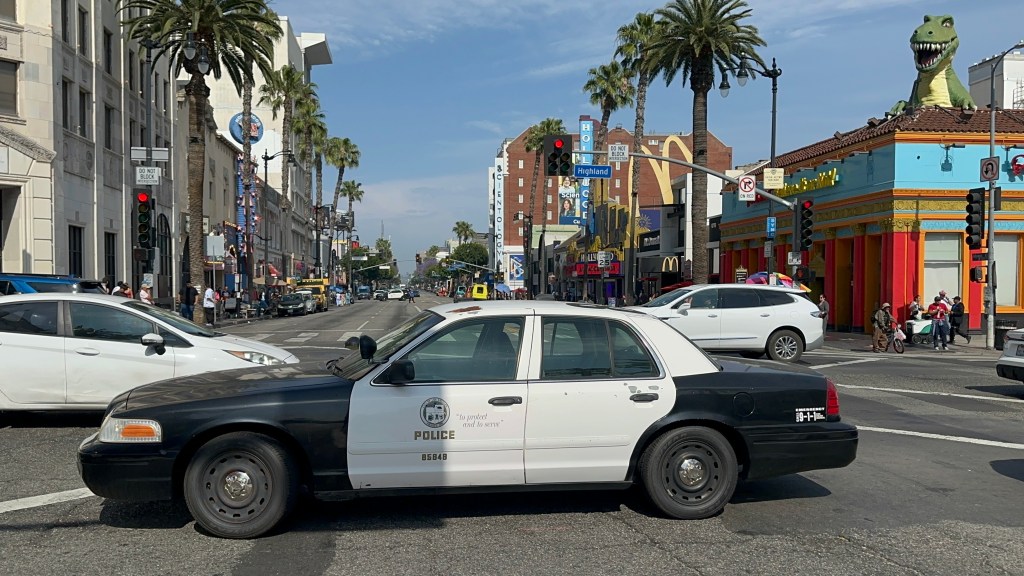
An LAPD Cruiser blocks traffic on Hollywood Boulevard in Los Angeles on May 31, 2025. (Sean Beckner-Carmitchel)
By Sean Beckner-Carmitchel
LOS ANGELES — The Los Angeles Police Department (LAPD) quietly acknowledged at least one officer participated in a law enforcement gang. Sources within LAPD told Ten Four that the officer was assigned to the Mission Division, which has been wracked with firings and controversy for several years. Members of the division’s Gang Enforcement Detail have been accused within the department of turning off body-worn video devices then robbing people they pulled over and illegally searched.
Make a one-time donation
Make a monthly donation
Make a yearly donation
Choose an amount
Or enter a custom amount
Your contribution is appreciated. Your one-time contribution is appreciated. Donations are always welcome, there is no paywall.
Your contribution is appreciated. Your one-time contribution is appreciated. Donations are always welcome, there is no paywall.
Your contribution is appreciated. Your one-time contribution is appreciated. Donations are always welcome, there is no paywall.
DonateDonate monthlyDonate yearlyThe acknowledgment that an officer participated in gang activity appeared in LAPD’s January 2026 disciplinary report, which summarizes sustained misconduct findings and penalties each month and is released publicly. Among the sustained complaints, an officer is listed as having “participated in a Law Enforcement Gang.” The report does not name the officer and says that since he is retired, he will not receive any professional discipline from the department.
LAPD does not regularly name officers it disciplines outside of police shootings, citing personnel confidentiality laws. Multiple law enforcement sources speaking on the condition of anonymity told Ten Four the officer was working in an anti-gang unit within the Mission Division.
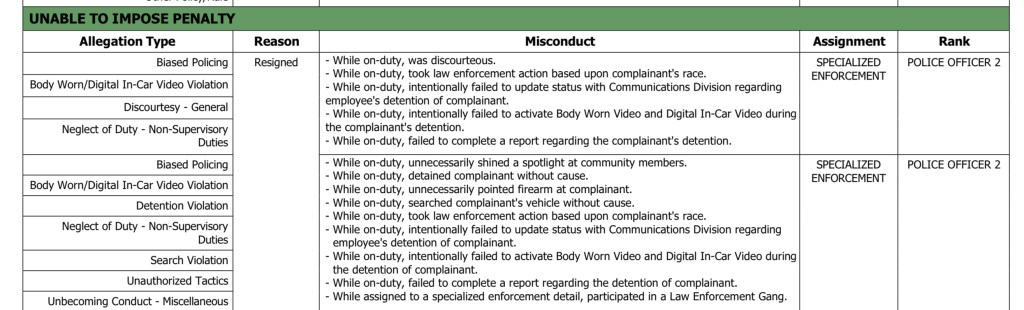
A list of incidents for one officer in January 2026’s disciplinary report (LAPD)
The sustained complaints on the officer describe a litany of alleged abuses of power: the officer “took law enforcement action” based on the complainant’s race, intentionally did not activate his body-worn video or dashcam video cameras, unnecessarily pointed a firearm at a complainant, and searched a complainant’s vehicle without cause. During at least one incident, the officer failed to update LAPD’s Communications Division or complete a report about a detention. It’s not currently known whether all of these events targeted one complainant or if these happened during several incidents.
Police accountability advocate account Film The Police LA first posted about the law enforcement gang mention on social media.
When asked for comment, representatives for Mayor Karen Bass referred the Ten Four to LAPD. LAPD responded to inquiries about these incidents and law enforcement gangs within the department by asking Ten Four to submit a public records request.
California state law defines a “law enforcement gang” as a group that engages in a pattern of on-duty behavior that “intentionally violates the law or fundamental principles of professional policing.” These patterns of behavior can include harassment or discrimination as well as the persistent practice of unlawful detention, excessive force, falsifying police reports.
The law requires that if law enforcement gang misconduct rises to the level of criminal allegations, the police department must refer the misconduct to the District Attorney’s Office or other prosecuting agencies.
Neither the United States Attorney’s office nor the Los Angeles County District Attorney’s office responded in time for publication to inquiries about investigations into Mission Division law enforcement gangs.
Alan Carrillo, an officer in the Mission Division at the time, was charged in 2023 for multiple on-duty misconduct incidents, including two counts of altering, planting or concealing evidence as a peace officer, and three counts of petty theft. In a 2023 statement, then-District Attorney George Gascón said “the public’s trust and the integrity of law enforcement are undermined when officers tamper with evidence and steal items from the public.”
In 2023, LAPD announced that “the Department is in consultation with the Los Angeles District Attorney’s Office” regarding invesitgations into the Mission Division. According to LAPD, the investigation had “been referred to the Public Corruption Civil Rights Section of the United States Attorney’s Office and the Federal Bureau of Investigation Civil Rights Division has initiated an investigation.”
According to the District Attorney, Carrillo allegedly stole metal brass knuckles and knives from individuals during pedestrian and traffic stops. Carrillo documented these items inconsistently in his reports, and the taken items were never recovered.
LAPD did not reply to an inquiry about how many of their officers are currently being investigated or disciplined for their participation in law enforcement gang activity. In 2024, the department began the process to fire several officers in the Mission Division.
Two LAPD supervisors have accused in lawsuits that top-level department leaders illegally falsified reports to the Board of Police Commissioners, LAPD’s highest disciplinary body. When they shared their concerns to their bosses, those bosses retaliated against them by transferring them to less prestigious assignments and disciplining them for minor infractions, the supervisors said. One of the lawsuits, filed by a high-ranking LAPD commander, alleges retaliation after raising concerns about bodycam misconduct within the department.
In May 2025, Commander Natalie Cortez filed a lawsuit in Los Angeles County Superior Court claiming she faced retaliation after corroborating wrongdoing involving body-worn camera compliance and use-of-force incidents. The suit claims Cortez told a superior that LAPD was providing false information to the Board of Police Commissioners. Cortez also alleges in the suit her bosses believed she planned to support Captain Johnny Smith, another LAPD supervisor, in his claims about a widespread lack of compliance in using body-worn cameras in a separate lawsuit.
Smith’s suit, filed in February of 2022, alleges that he was retaliated against after reporting a lack of compliance with body-worn camera requirements and officers’ misuse of less-lethal bean bag rounds on protestors in 2020.
Cortez’ suit, first reported at LA Public Press, alleges she told her superiors that some officers routinely failed to activate their body-worn cameras and that department officials provided misleading information about body-worn camera compliance rates to the civilian police commission.
The suit alleges that Cortez was later transferred from a “prestigious” assignment in Operations Valley Bureau to Transit Services Group, which Cortez characterizes as a demotion, limiting opportunities to advance. The city has denied wrongdoing in this case, which remains pending.
Disciplining an officer for participation in a law enforcement gang could set a precent for future civil litigation. Plaintiffs’ attorneys in excessive force or civil rights cases often seek to introduce evidence of clique membership to argue bias, pattern or motive.
Allegations of law enforcement gangs are not unique to the LAPD. The Los Angeles County Sheriff’s Department has faced years of scrutiny over accusations that its patrol stations and jails have dozens of them. Lawsuits and investigations have identified deputy groups with names including the Banditos, Executioners and Vikings.
A 2022 report commissioned by the county Civilian Oversight Commission concluded that deputy gangs have existed within the department for decades. LASD leadership repeatedly denied tolerating “gang” activity for years, and it was a central issue to voters in the ousting of Sheriff Alex Villanueva in 2022.
The controversy echoes the Rampart Scandal, one of the most infamous corruption scandals in American policing. In the late 1990s, officers assigned to the CRASH (Community Resources Against Street Hoodlums) unit in the Rampart Division were implicated in widespread misconduct. More than 100 criminal convictions were overturned as a result of the scandal. The fallout led to a federal civil rights investigation and a consent decree between the city and the U.S. Department of Justice.
 LA Ten Four
Leave a comment