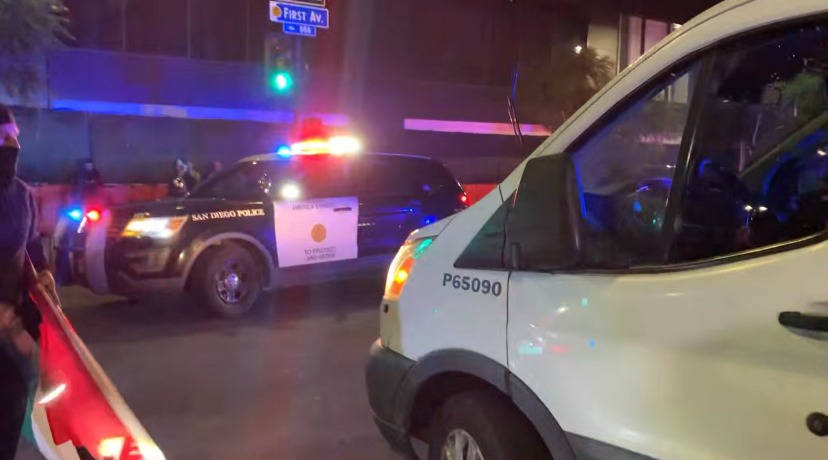
San Diego Police redirect a DHS transport van away from anti-ICE protesters during a heated confrontation in downtown on January 8, 2026. (Jake Lee Green / Aeon Photo Co.)
By Jake Lee Green
Jake Lee Green is the former Managing Editor of the Kern Valley Sun and contributor to the Kern Valley Independent. He is a freelance photojournalist working under contract with ZUMA Press, SIPA USA, NEWS2SHARE, and a regular contributor to FreedomNews TV. His work has appeared via wire services including the Associated Press, Reuters, Europa Press, and Kyodo News Agency.
He reports on labor, social justice, indigenous rights, crime, culture, and far-right militancy, with a focus on fringe movements and underreported communities. His venmo can be found here.
San Diego – As of Feb.13, 2026, the City of San Diego ended its Media Identification Card (Press Pass) Program. The long-standing press pass program and accompanying parking placard were key tools for freelance, broadcast and other news media journalists who used them for ease of access into standoffs, fires, traffic collisions, protests, natural disasters, and other behind police line coverage.
Make a one-time donation
Make a monthly donation
Make a yearly donation
Choose an amount
Or enter a custom amount
Your contribution is appreciated. Your one-time contribution is appreciated. Donations are always welcome, there is no paywall.
Your contribution is appreciated. Your one-time contribution is appreciated. Donations are always welcome, there is no paywall.
Your contribution is appreciated. Your one-time contribution is appreciated. Donations are always welcome, there is no paywall.
DonateDonate monthlyDonate yearlyA written letter signed by San Diego Police Chief Scott Wahl was released to SDPD’s “Media Partners” explaining their reasoning behind the decision. Many freelance photographers, writers and associated media members were taken aback by the program’s end and expressed concern to Ten Four over how it will affect future access.
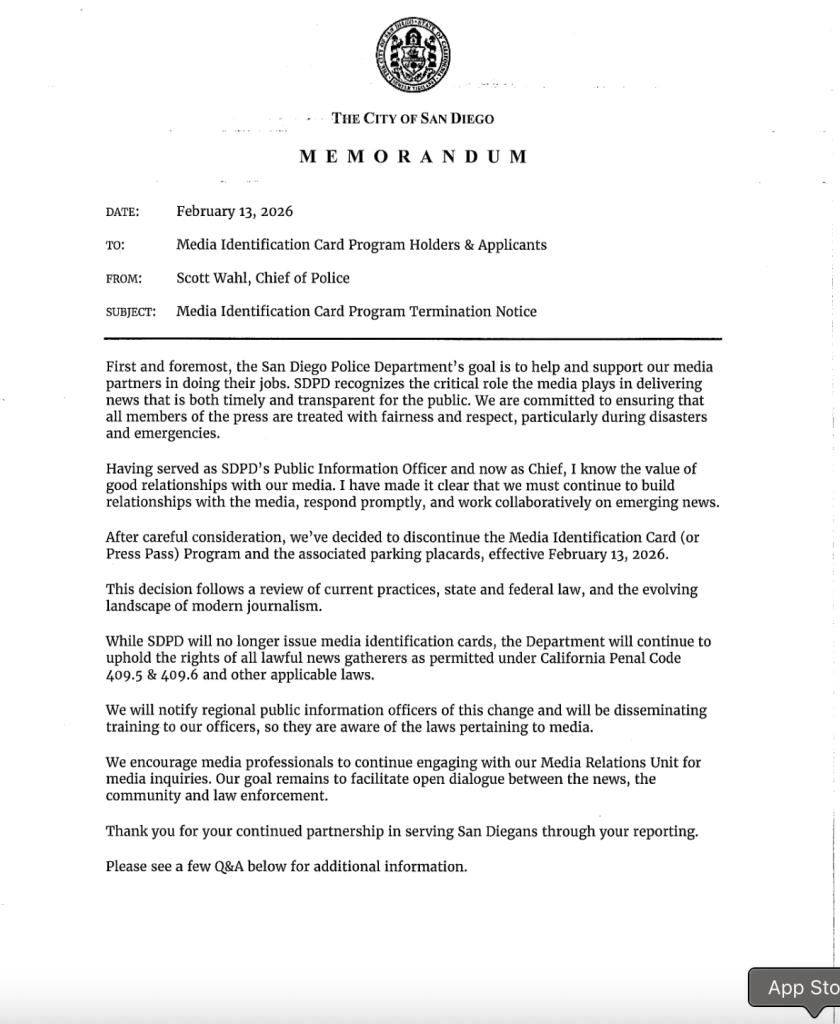
Memo from Chief Scott Wahl to “Media Partners” sent out on February 13, 2026. (Screenshot, City of San Diego)
Communications Manager for the Chief’s Office of the San Diego Police Department (SDPD) Ashley Nicholes explained the decision “did not come lightly” and that the department deliberated for years to come to a final decision. “It wasn’t something on a whim that we decided.” Nicholes also said “[SDPD] brought in some of the big news outlets to kind of gauge their feedback.” Despite the feedback that happened between the local broadcast and print media in San Diego and the City, the decision came as a shock to many of the SDPD card carrying media professionals.
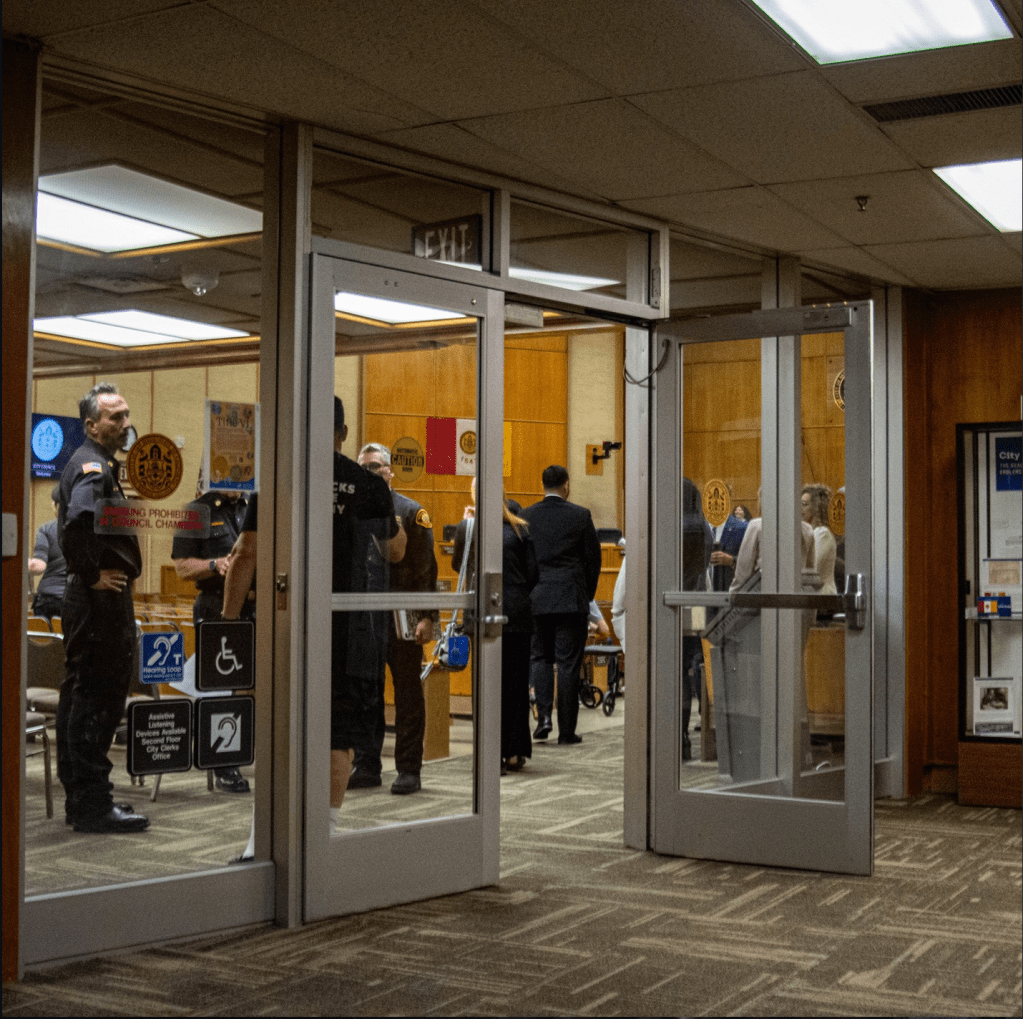
San Diego City Council Chambers; February 2, 2026 (Jake Lee Green – Aeon Photo Co.)
In the e-mail addressed to SDPD’s “Media Partners”, Nicholes mentions these changes had come “after reviewing our practices, applicable law, and the evolving media landscape.” After following up with her about the e-mail and accompanying letter, Nicholes told Ten Four that ending the program was never about denying access for the press but that it is meant to streamline and adapt to the changing face of the news industry.
With the rise of independent media, influencers, commentators and auditors reporting on SDPD and city operations, the plan to scrap the press badge program invokes a great deal of questions from police on who is “considered press,” with the new training being implemented by SDPD.
“This is extremely disappointing from our local police department while our federal government has been attacking the freedom of the press”, said ZUMA Press and Ten Four contributor Jonathon Cheng. “Having a press ID card has kept me safe from arrest by police while working as a photojournalist.”
Both Nichols and Wahl have stated that they will “uphold the rights of all lawful news gatherers,” but in the absence of the sanctioned press passes freelance journalists are left with the task of identifying themselves with homemade credentials or credentials from organizations like the National Press Photographers Association. Nicholes has asked these “Media Partners” to “please create something that identifies you.”
Freelance photojournalist Rashad Griffin Sr. expressed his concern, saying “In fast-moving situations, seconds matter. Clear identification matters. When press credentials are dismissed or minimized, it not only endangers journalists physically, it weakens transparency and accountability for everyone.”
The protections that come with having a sanctioned press badge marked with the SDPD initials: it is unmistakable to law enforcement and city officials in San Diego. Griffin went on to state, “as a working photojournalist, carrying a valid press ID has not been about privilege; it has been about protection, clarity and safety.”
Griffin makes a solid point, but it does bring into question how the city will validate who has access and who does not; even with self-appointed credentials. Government issued press access is in itself a controversial subject among many journalists. Given that freedom of the press is a right granted to all citizens not to be impeded.
In one case of impediment, a reporter for the San Diego Reader and contributor to the right-wing wing website The Post Millennial, Eva Knott found her press pass revoked after alleged complaints from USA Today reporter Will Carless. The complaints, according to a lawsuit against SDPD from Knott, were that she had been given credentials under a pen name. In court filings, Knott alleged in 2024 that she was told her pass was revoked because she does not regularly cross police and fire lines. Despite the decision by the city, Knott stated in her suit that her regular courtroom visits and attending a protest in Pacific Beach in 2021 on behalf of her reporting were enough to maintain an active pass.
Deputy Director of Advocacy for Freedom of the Press Foundation (FPF), Adam Rose gave some context to the rarity of city issued press passes. “Maybe a dozen departments issue them. Usually they abandon the programs after a few years”. Rose continued, “our perspective in California is a little distorted because this is the region that seems to have the most departments with a press pass program. But even those are falling out of favor.” He listed several cities that have done away with their programs which include Boston, Dallas County, Houston, Las Vegas, Massachusetts State, and Washington D.C.
In Los Angeles, where Rose conducts most of his work, LAPD and LASD still implement a press pass program. Although, he mentions that “they each only make about 7% of the passes they issued a generation ago — and the rumor is that might be down to 3%.”
The memo released by Wahl does nod to California state law which is designed to allow journalists to enter, remain in, and report from protest zones without interference from law enforcement. But the departure from the SDPD press badge system makes unclear the future of media recognition despite reassurances by city officials.
Aside from personal identification, the revocation of the parking placard puts the press in a difficult position to jockey for parking in an already difficult landscape of high priced meters, closed lots, overcrowded areas and no parking zones where the discretion to enforce city ordinance is with SDPD. The “Vehicle Identification Placard” granted access to “permit parking in yellow zones, white zones, time zones, and parking meters” for press member’s vehicles “while engaged in the course of their duties.”
It is unclear at this time how the SDPD intends to train their officers in the “stand-alone procedure for first amendment activities,” however SDPD claims they intend to recognize all press badges and parking placards issued until the date of expiration. They have also made clear that the program will not be resurrected at any time in the future.
 LA Ten Four
Leave a comment