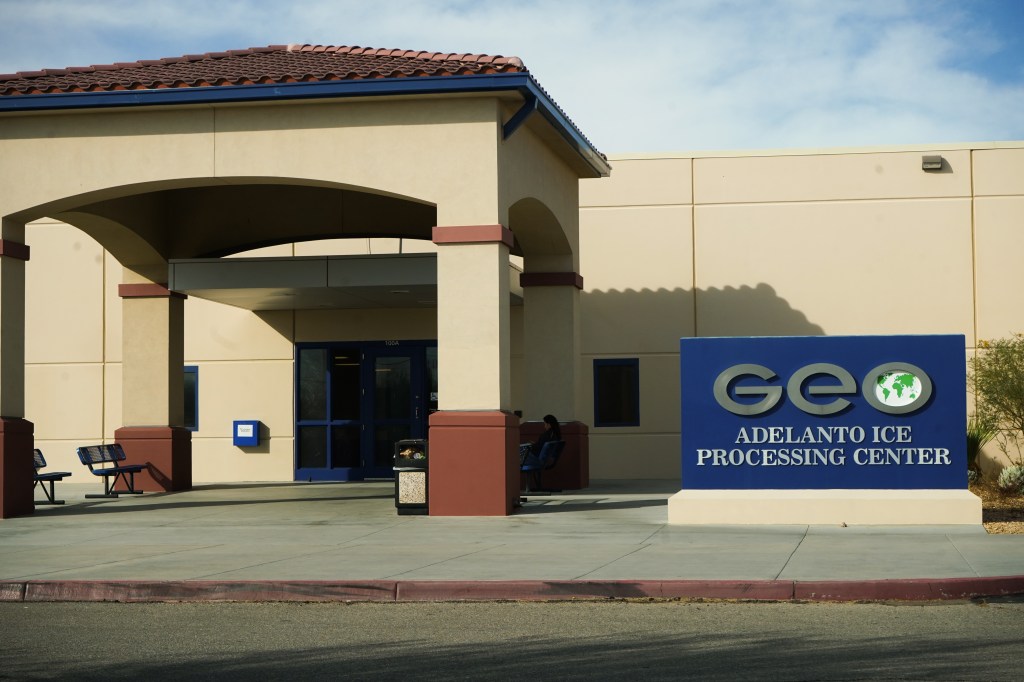
The facility itself and its conditions inside are the subject of dozens of stories, but rarely is there an opportunity to actually talk to those inside the facility.
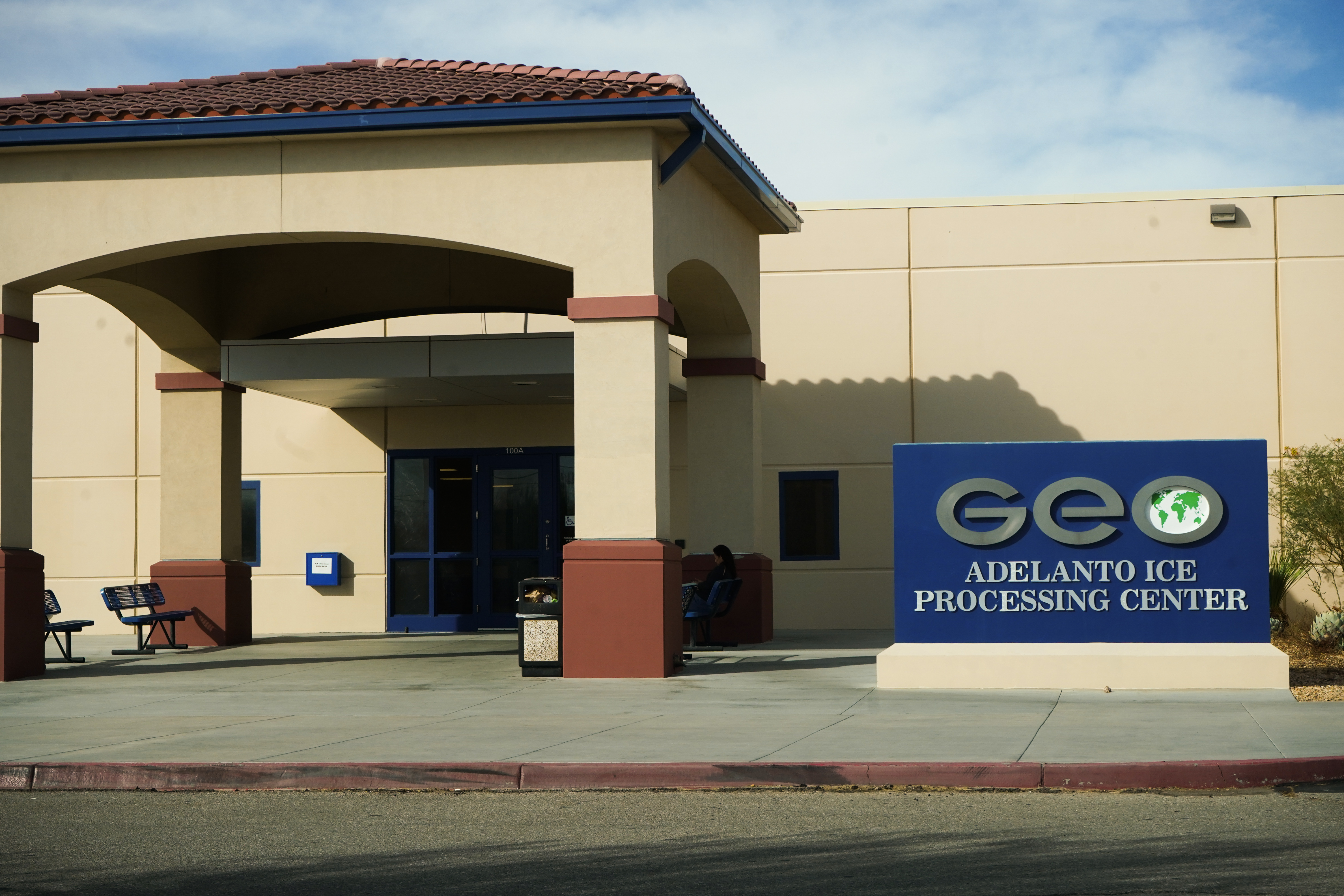
The entrance to Adelanto ICE Processing Facility in Adelanto, CA on October 25, 2025 (Sean Beckner-Carmitchel)
By Sean Beckner-Carmitchel
ADELANTO – On October 25, Ten Four visited the Adelanto ICE Processing Center in Adelanto, CA. Another reporter with another outlet had made contact with a detainee, and had arranged for visitation with them alongside Ten Four.
Visitors pass through layers of security and silence to see those inside. Many haven’t seen their loved ones since they were detained by immigration authorities in Southern California. The facility itself and its conditions inside are the subject of dozens of stories, but rarely is there an opportunity to actually talk to those inside the facility.
Make a one-time donation
Make a monthly donation
Make a yearly donation
Choose an amount
Or enter a custom amount
Your contribution is appreciated. Your one-time contribution is appreciated. Donations are always welcome, there is no paywall.
Your contribution is appreciated. Your one-time contribution is appreciated. Donations are always welcome, there is no paywall.
Your contribution is appreciated. Your one-time contribution is appreciated. Donations are always welcome, there is no paywall.
DonateDonate monthlyDonate yearlyNote: Names of detainees and their visitors are kept anonymous throughout the piece to prevent potential reprisal against the detainees.
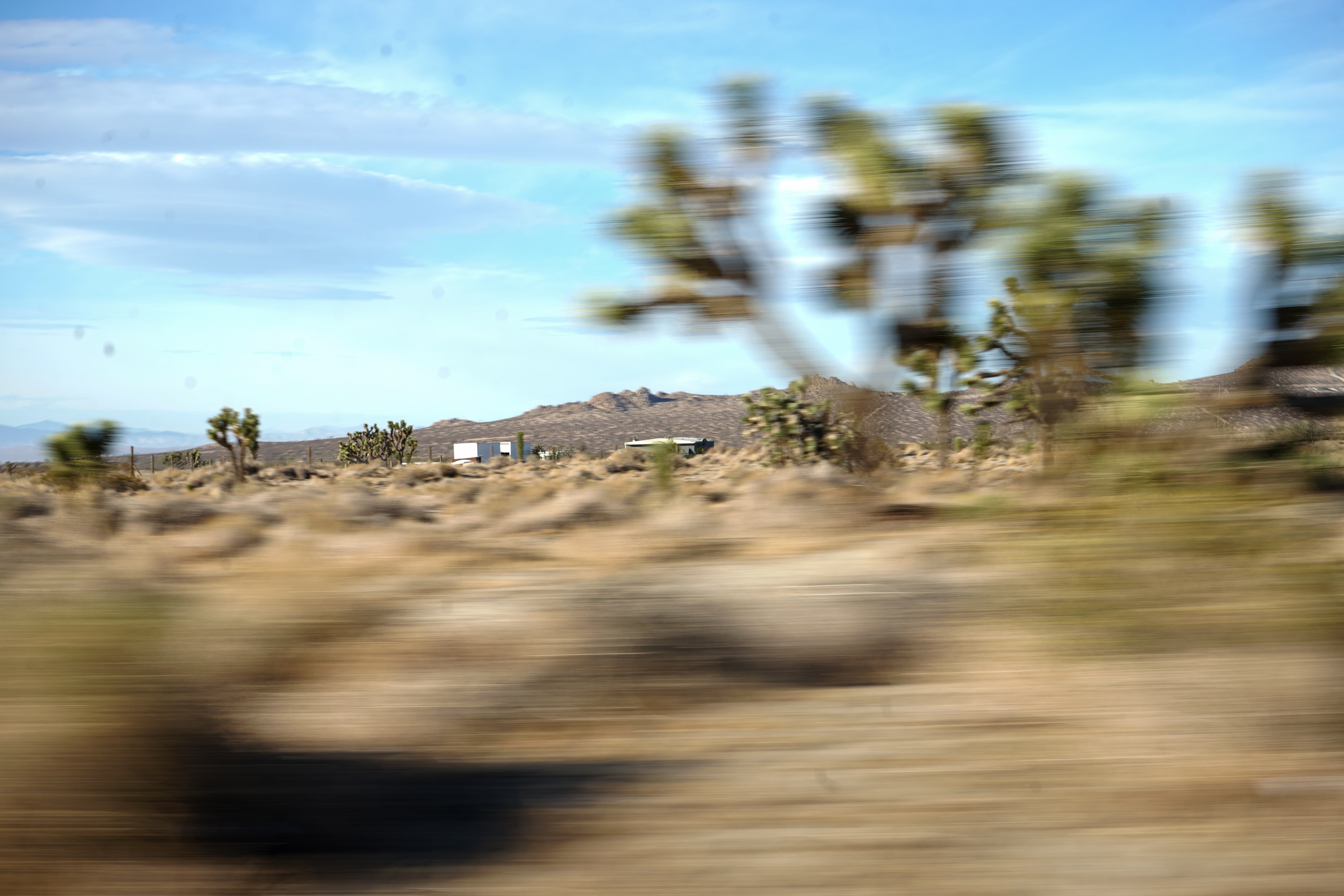
The way to Adelanto from Los Angeles cuts through shrubs, desert and a surprising amount of marijuana dispensaries. The desert sky flattens things on the way there. Large rocks jutting through the sky seem much smaller once you cut through them. That hot desert sun blares onto tiny Joshua Trees and shrubs seem flat alongside the San Gabriel mountain range.
A sign lets you know you’re close and the long drive is nearly complete. It reads “WELCOME City of Adelanto; THE CITY WITH UNLIMITED POSSIBILITIES.” Given reports of the facility’s conditions; it feels as much like a harbinger of what might happen as it does an innocuous greeting. The facility is in many ways one of the hearts of commerce and employment in the city of Adelanto. In Spanish, the word adelanto means either “advancement,” or “progress.”
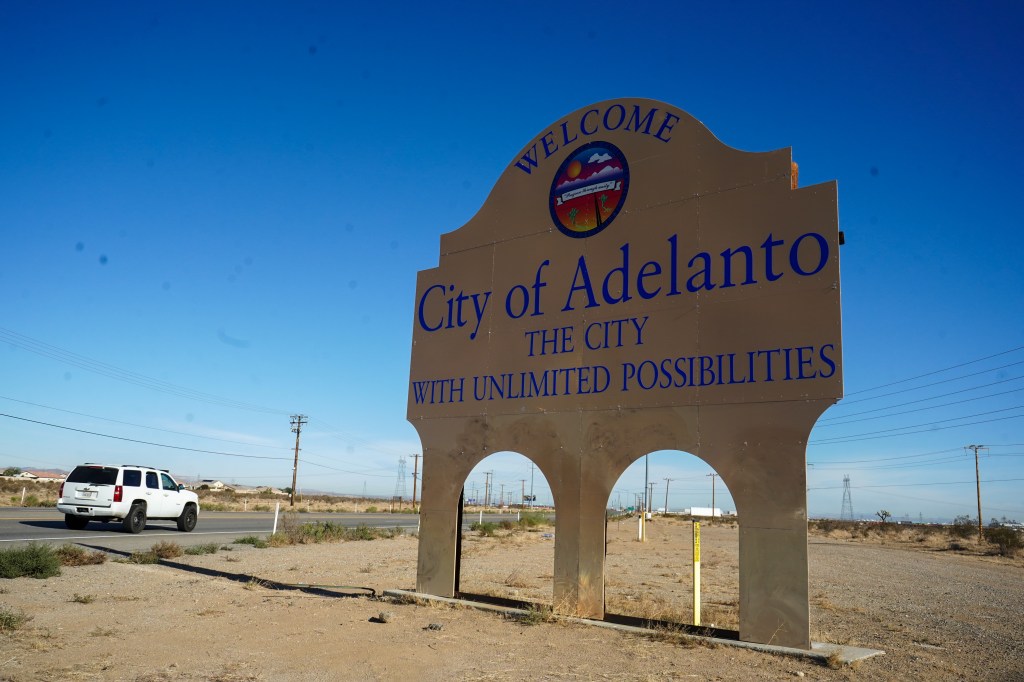
The welcome sign to Adelanto, CA (Sean Beckner-Carmitchel)
The facility itself is run by GEO Group, a public corporation that has 23,000 employees and lists itself as a “private corrections company,” in a recent news article about their stock share prices dropping nearly 10% today. They have 97 facilities throughout the world; most of them are in the United States.
GEO describes themselves as a company striving “each day to provide high-quality services in safe, secure, and humane environments.” Their “focus is rehabilitative, not punitive, and our goal is to be the world’s leading provider of evidence-based rehabilitation by helping those men and women entrusted to our care to prepare them for successful reentry into society.”
Almost none of those in custody in their Adelanto ICE detention facility will actually reenter the society they lived in when they were taken there. Most of them will be deported. A few have died. GEO says they provide “complementary, turnkey solutions for numerous government partners worldwide.” Given their status as a leader in the big business of detention centers in the United States, the words “turnkey solutions,” feels it could be a joke.
Shiny chrome fences surround the Adelanto ICE Detention Facility. Though nearly everything else outside the facility is a beige or forest green color there’s clearly some pride in making sure you know the gates themselves are new. There’s a lot about the facility that tells you what those that run it find important. Fences are new, reflecting the desert sun overhead. It seems as though someone wants to make sure that you know the fences are a priority.
Even before you walk inside the facility, you see signs that there is a great deal of work put in to give you a sense that this facility is UNDER CONTROL. This is not a place for emotion. It’s a sterile place, and any outbursts will not be appreciated. Once you drive through signs that tell you that you’re at the Adelanto ICE Detention facility, you see signs that tell you that you cannot record within this facility.
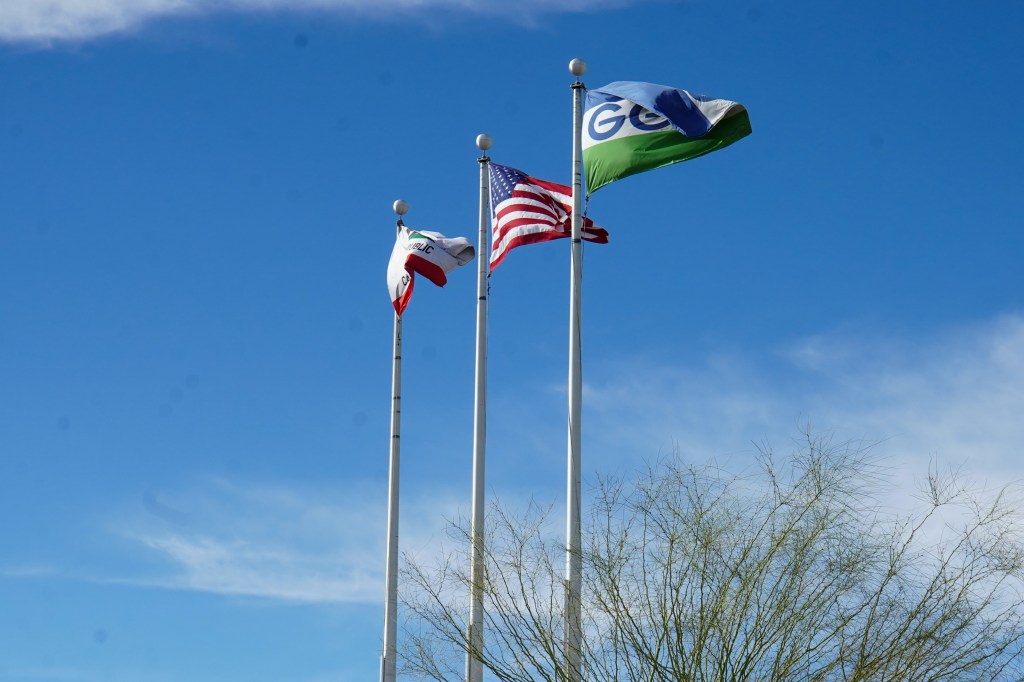
The California, United States and GEO Group flag all fly next to each outside the Adelanto ICE Processing facility on October 25, 2025 (Sean Beckner-Carmitchel)
The United States flag is flown near the entrance to the facility alongside the logo of GEO Group and the California state flag. This is a violation of established “flag code,” according to some. Prescribed rules dictate that the flag of the United States must fly above the flags of states and especially large multinational corporations.
Walking in, the desert outside: open, infinite, full of light, wild, dangerous — and this place are in stark conflict: controlled, beige, and in a manufactured stasis. It is a simulation of safety for people on the outside who have likely never really felt unsafe.
A woman walks up to me. Her face is beet red, and she walked through the facility’s parking lot. The woman’s eyes cried themselves swollen. As she walks, she doesn’t appear to be walking in one direction towards her vehicle. She’s just walking.
Once you walk in, the first thing inside on your right are computer terminals advertising you can “buy phone Minutes HERE,” and “minutes para llamados COMPRE AQUI.” Expect that your “deposit will be subject to an additional.5 plus 7% minimum of .35 in local, county, state and federal surcharges and regulatory costs.” This is, after all, a place of business. There will be no freeloaders at this facility doing things like making free phone calls to family members. You can also, if you like, add funds to a commissary account.
Unseen, walking through the hallways of the facility was a wailing child. The sound echoed through a long hallway that leads to the visitation room.
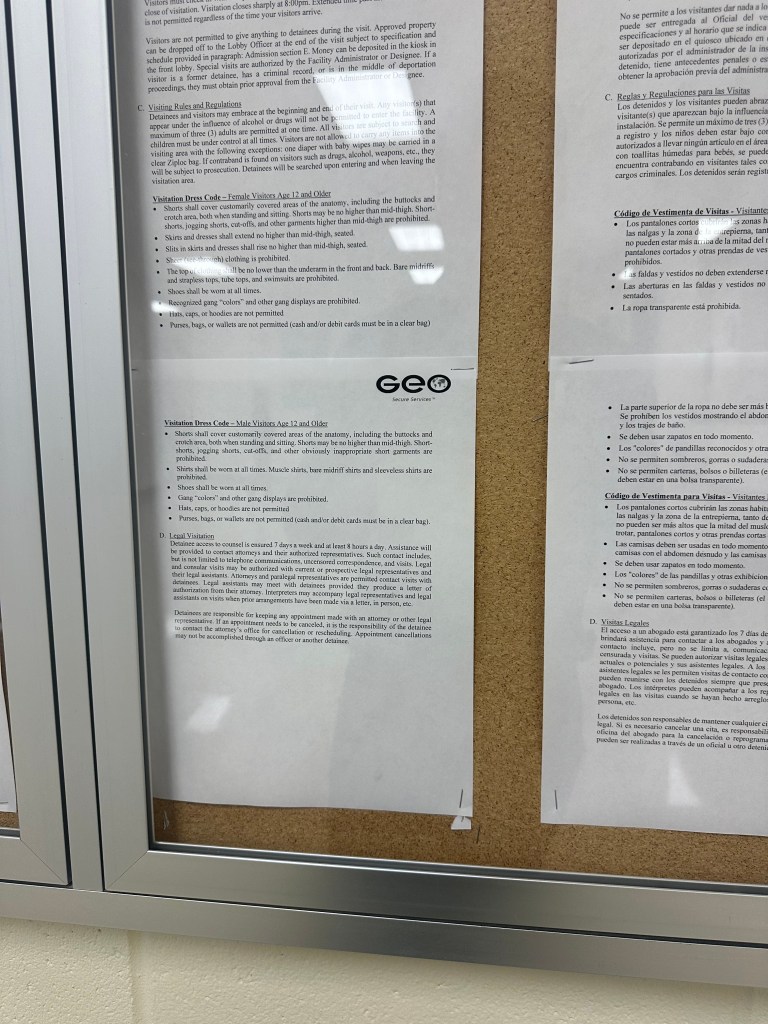
A bulletin board shows a series of rules for visitation at the Adelanto ICE Processing facility in Adelanto, CA on October 25, 2025
One woman told me the dress code within the facility prevented her from going in. She wouldn’t be able to go into the visitation room, because her sweatpants and t-shirt were not allowed.. Her face was worried, her breathing fast. Not long after, another person arrived with a change of clothes for her.
Some people waited for hours. To pass the time, it’s common to focus on the small details here.
Rows of blue plastic chairs line up the center of the visitation waiting room. White droplets paint the bottom of nailed down black legs of the chairs and suggest the room is mopped often and hastily. Several televisions are in the waiting room; none of them were turned on. A magazine rack provided free complimentary reading to pass the time. Those magazines are stiff, tattered and from May 2022. One clock in the room is watched closely, and nearly everyone checks it with regularity.
Lockers without locks line up a wall on one side of the room in front of some restrooms. A tiny plastic table with plastic chairs was in front of those lockers; a place where children ostensibly could play. There are a lot of children that went in and out of this room, but very few use it. Children there are mostly held tight by their guardians. A coat of dirt is visible. Colors on the furniture were faded from oxidation, and there was a slight yellow tint to the furniture.
This waiting room advertised what’s inside, and appears designed to reassure visitors. Or maybe the employees. Signs advertise items mandated by case law, international law, common decency, judge’s orders or the United States’ Constitution. Some of these things have not been provided to those in custody at Adelanto ICE Detention Facility according to reports and lawsuits. Signs read “dental services,” “examination room,” “housing day room with TVs,” “telephones provided in housing,” “legal library,” and “general library.” Photos of soothing beaches are intermixed with the signs, and one sign features a picture of a platte with the words “wonder” printed in big letters underneath.
According to the ACLU of Southern California, detainees at Adelanto faced severely restricted, non-confidential, and expensive phone access. Calls were cut if not immediately answered. Detainees were often unable to leave voicemails, had to navigate complex automated menus and sometimes were unable to speak with attorneys or legal organizations. The lawsuit also states that the facilities offered few or no private consultation rooms, which forced detainees to meet with their attorneys in places where conversations could be overheard.
A little girl in a pink Wicked shirt from Honduras waited to see her step-father next to a complete stranger. The stranger was kind to her, and they passed time speaking to each other. I overheard snippets of conversation between this woman and the child.
“How old are you,” the stranger asks. She’s 11.
The stranger asked how her step-father was detained. The girl hadn’t seen her step-father since he was detained in mid-August. The step-father ran when he saw immigration agents; they chased him and took him. He ended up at Adelanto.
The stranger showed pictures of a vacation in El Salvador. The girl asked about the many volcanoes in El Salvador. Was this stranger in a subtle way is preparing this girl for her step-father to go back there? The girl attempted to put on a stoic face; but she crossed her arms while nervously and anxiously kicking her legs.
The stranger showed the girl more pictures of the vacation. There was a perk when she saw El Salvador’s National Palace. “It looks like where Donald Trump lives,” the girl exclaims.
Employees of GEO Group walked in, clocked in and began their work day. Workers usually carried a neutral “another day at the office,” look. Most workers carried clear plastic bags to facilitate speed of entry through the security checkpoint. Many employees carried Starbucks iced lattes with them; a few that went in beamed as they brought extra drinks for a favorite co-worker. Almost none of those walking in wearing a GEO uniform made eye contact with those in the waiting room.
Some of the employees laughed and made private office jokes you’d hear at any other regular office job in the United States of America. There were jokes about Mondays, work husbands/wives and the occasional bright light of excitement came when seeing favorite co-workers. “Ayyyy, what’s up homie?” one GEO employee said to an entering co-worker. “Chillin?” the GEO worker asked his friend.
Next to the punch in/out system for GEO employees are gigantic posters that must by California law be placed in an area where their employees see them. In both Spanish and English, employees are informed that their rights are protected by the Department of Labor both federally and by the State Of California.
GEO Group punished detainees housed in a Bakersfield detention facility that participated in a work stoppage to protest wages and other working conditions, according to a complaint by the National Labor Relations Board. The complaint alleges that they had commissary privileges revoked and placed in solitary confinement, and was later dropped.
To the left, flyers advertised a new program giving $1,000 as a stipend for immigrants who traveled to the United States without proper documentation to “facilitate travel back to their home country through the CBP Home App.” In addition to “financial and travel assistance,” they’ll be “paid after their return to their home country has been confirmed through the app.” The flyers are in at least 11 different languages. The Department of Homeland Security (DHS) says that this program will “decrease the costs of a deportation by around 70 percent. Currently the average cost to arrest, detain, and remove an illegal alien is $17,121.”
It’s hard not to notice a few things in that waiting room, and hard not to wonder of their significance. Over hours, dozens of people waited to go in; the entire time I was there I was almost always the only white person. In the room, there was noticeable self-segregation organized by native language. Pockets of people spoke Spanish with each other. Another pocket of people spoke Mandarin as they sat alongside each other.
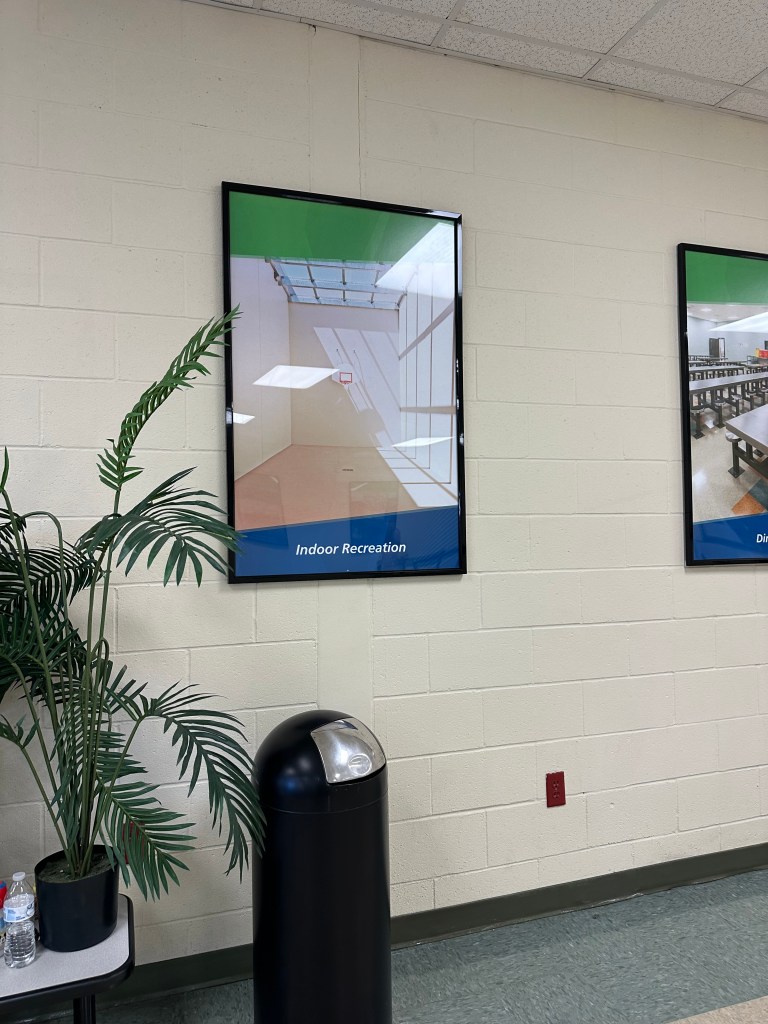
A sign reads “indoor recreation,” within the waiting room of Adelanto ICE Processing facility on October 25, 2025
It’s hard not to notice how many people that enter and exit this facility are children. Many of them attempted to do children things; they’d walk around, ask questions about things less immediately pressing. It’s hard to imagine how a child could easily digest the concept of a man in their life potentially never seeing the open air within the United States of America next to them again. They for the most part remain outwardly optimistic outside of moments where they began to realize what’s going on, nearly always resulting in a loud cry.
If you pay attention to their faces, you can easily learn what a woman’s relationship is to who they’re visiting at the waiting room. You can also easily decipher how long the man they’re visiting has been at the detention center. Women with dark circles in their eyes, nervously and fearfully speaking quickly seem likely to be there to see their romantic partner.
Over time, it seems, they begin to switch from emotional concerns to economic ones and a steely resolve breaks through once they realize they must now run the finances and emotions of their household alone. Mothers put on a brave face for their boys. Sisters are almost always there to serve as a glue and usually seem to speak the best English; they often are there as much to hold up the mothers and wives as they are there for their brother.
One woman ran the check-in counter, and held sway over whether you get to visit. Several times, she told visitors they are not allowed to bring in anything into the visitation room: no notepads, no phones, not even a wallet. Those lockers without functioning locks are nearby but most people elect to put all of their things in nearby vehicles.
The woman running this check-in counter only speaks English. She doesn’t speak Spanish, she doesn’t speak Mandarin, and never attempted to use any sort of language translator. Some people listened to her. They did the thing that a lot of people do when faced with bureaucratic instructions in a language they do not speak: nodded politely, and watched what other people do then mimicked them.
In big red letters, the exit door of the hallway to the visitation room read “no entry, exit only.” Another piece of odd wording that feels like a joke.
A woman began crying while speaking to the check-in woman. Her husband and the father of her four children is here. He was taken by immigration agents at a courthouse in Compton. His name was no longer in the system, the check-in woman told her. Tears began to run down her face and she barely understood what she’s being told. There was not only a language barrier but this is a Complicated Bureaucratic Glitch that only happens sometimes and sometimes fixes itself. The check-in woman tells her “this happens sometimes.”
After being taken from a courthouse in Compton, the woman tells me, he was taken to B-18; the detention area at Metropolitan Detention Center. She was able to visit him there for 10 minutes. A proud smile began to crack through her tears after she was asked about her four children, their ages, and what they’re like. A few seconds after her smile, her face returns to worry.
Furious checks to run the man’s detention number and name were unsuccessful. She begins to google “abogados de inmigración.” Just a few minutes later, he was back in the system. She’ll be able to visit him at this detention center.
One man left the waiting room, telling his family he’d return soon. Outside, he leaned over an old Toyota and smoked. His cigarettes were from Korea, and he gave me one. While we smoked silently, he interrupted the quiet by telling me he’s worried that he will never be able to see his son again. He turned his head away. He didn’t seem to expect a response, and probably didn’t want one.
Adelanto is a “prison town.” It’s a common term. As rural communities compete to host prisons in the idea of advancing their economic interests, at least one study shows that well below half of the jobs in prisons like this one in Adelanto go to people living within that community’s borders.
In a city of just 38,000 people there are thousands of people whose head will hit the pillow within a prison or detention facility every night. When nearby George Air Force base closed in 1992, it erased the town’s residents from their main source of employment and limited the city’s main source of revenue. In 1991, the facility that is now a part of the Adelanto Ice Detention Facility was built.
Those facilities have failed to turn back the tide of poverty within the city, and 16.4% of Adelanto’s residents live below the poverty line. That number is more than ¼ higher than California’s average.
In 2015, the city of Adelanto permitted the growth of medical cannabis. An attempt to steer the course towards a different opportunity. In 2017, Mayor Richard Kerr said he’d turn Adelanto into a “Silicon Valley of medical marijuana.” Kerr was eventually taken out of his house by police and given corruption charges. A tagline of Crooked Media’s podcast on Adelanto’s attempted cannabis industry reinvention reads “and it worked…for a while. Until it, spectacularly, didn’t.”
Adelanto even has a Cannabis Scholarship Program. Several high school students on, and in a statement their City Manager Jessie Flores said “The scholarship funds, disbursed directly to educational institutions, aim to alleviate financial burdens and support students in pursuing higher education.” “It is an honor for the city to support these remarkable students in their pursuit of higher learning,” Flores said.
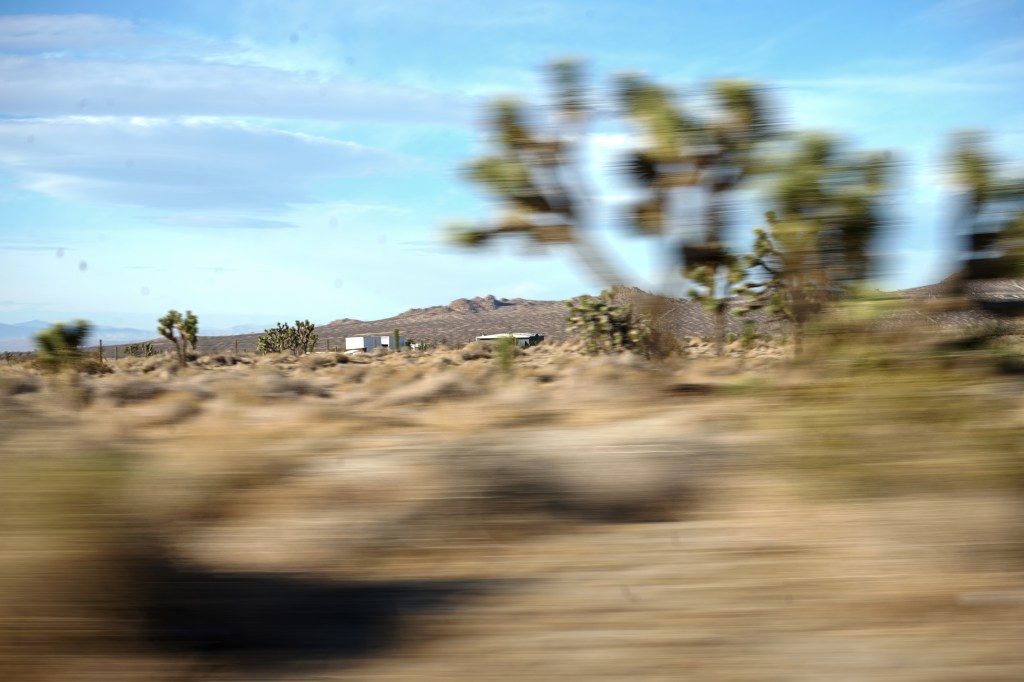
Joshua Trees outside Adelanto, CA (Sean Beckner-Carmitchel)
In 2024, a mass murder in the dark deserts was the result of an illegal marijuana grow dispute in an unincorporated desert area of Adelanto. When Sheriffs arrived they found six dead.
In 2020, a group called The Shut Down Adelanto Coalition began releasing their list of potential environmental hazards at Adelanto ICE Processing facility. They claim there’s misuse of a cleaning chemical (pesticide) called HDQ Neutral, contaminated water, and horrible air quality coming from other toxic sites like the former George Air Force Base in close proximity to the detention center.
The contaminated water within the facility has led to reports of many of the employees refusing to drink the water within Adelanto. Nearly every employee walking inside during our visit there held bottled water or a large nalgene bottle. And in one study of the contaminated water by The Shut Down Adelanto Coalition, a woman describes developing “cysts inside my pancreas and belly due to the contained water that I was consuming. To this day, I still have them and medical personnel have advised me to be very cautious because it can easily develop into cancer.”
Outside of the facility, there are concerns raised by immigration and environmental advocates that the chemicals could be affecting residents of the town that aren’t incarcerated. The same study warns “all residents, whether incarcerated or not, share the same water source.
When it’s time to visit a detainee, everyone went into a single file line. They were told you may not, under any circumstances, have gum. People removed belts, and went through a metal detector. People were reminded once again that they may not have any items past the security checkpoint. Children’s hands were firmly clasped; they must not wander and they must remain in line.
Visitors were then told to remain against a wall within a long hallway past the checkpoint. They were escorted past a courtroom; a small room with small windows showing off an empty room. Offices for GEO Group are lined by gray carpet cubicles visible on the way to Room 234B.
Led to a locked room, dozens of visitors filed into a room that quickly became cramped. Once everyone was in, an electronic click was heard; both sides were locked.
Visitors are once again told about THE RULES. You are allowed physical contact twice; once when you enter and once when you leave. You may not lean too closely to the detainees. You may not pass anything to the detainees. You must leave when they tell you to. You must remain seated.
Though the room is cramped, a feeling of joyous relief was felt. People visiting these detainees put on a brave face. Many lectured their children multiple times. There were hugs, and many of the women there quickly managed their hair ahead of seeing their romantic partners for the first time since they’ve been detained.
Detainees also filed into a single file line through a small window leading into Room 234B at the Adelanto ICE Detention Center. They have faces of excitement: many of them hadn’t seen their families since they arrived. A few of the men anxiously smiled and excitedly adjusted their posture, but not so much as to receive more than a wary stare from detention employees monitoring them.
Once everyone is seated, there were long hugs. A few detainees are able to briefly hoist their children triumphantly. The interactions were chaste; there were few kisses and hands remain above the sacral region when men and women embraced.
One family received what must be the greatest seats in the house. The child was able to play with a bead roller coaster as they spoke. One child stared longingly at the bead roller coaster for minutes during the visitation.
As we spoke to the detainee we came to visit, some women in their 20s cried as their partners looked dejectedly down at the linoleum floor. Mothers seemed to prioritize looking strong for their sons detained in Adelanto. Workers in GEO uniforms looked on, and stared back at any eyes crossing theirs.
One family sat alone, progressively looking defeated. As others exchanged glances with detainees they visited, that family stared at empty seats for several minutes. They spent those minutes looking at couples, families and friends exchanging pleasantries. Eventually, two members of their family came into the room. They were not given extra time.
A detainee sat alone in his wheelchair across the room. His eyes were also wandering throughout the room; his curly black hair seemed less contained than the other detainees. The man we came to visit told me that he has seizures, and medical problems. As he slumped in his wheelchair, the man we came to visit said that he wasn’t in a wheelchair when he arrived. He wasn’t being given access to medical care when he needed it, and has a kidney infection now.
Later, the man in the wheelchair’s family arrived. They seemed more worried than a lot of the other families. I saw a mother’s face wrap around her mouth as they spoke. Afterwards, the man in the wheelchair’s mother told me that he told her he didn’t get emergency medical help multiple times. This has been an issue raised regarding the Adelanto Detention Center multiple times.
Visitors were then told there were 10 more minutes until the end of the visitation. Conversations became more intimate; some became louder and some became whispers. A few attempted to hug but were rebuked. It was not time to hug yet.
When the time was up, GEO Group workers got up from their desks and monitored physical contact. The rules are the rules, and compliance seems to be the key. They were then led out back into the room adjoining 234B.
As the visitors left, they once again congregated in front of a window facing detainees. Both sides of the room were locked. It is much louder, and much more grief can be felt among those that just completed their visit. Women faced away from the tiny window, once again fixed their hair, and removed their frowns and tears. They stood in front of the window for just seconds, smiled, waved, then faced away from the window once their improvised turn at the window expired. Nearly all of them immediately face away from the window and cry.
 LA Ten Four
Leave a comment