
By Sean Beckner-Carmitchel
LA’s City Controller Audits LAPD’s Mental Health Units
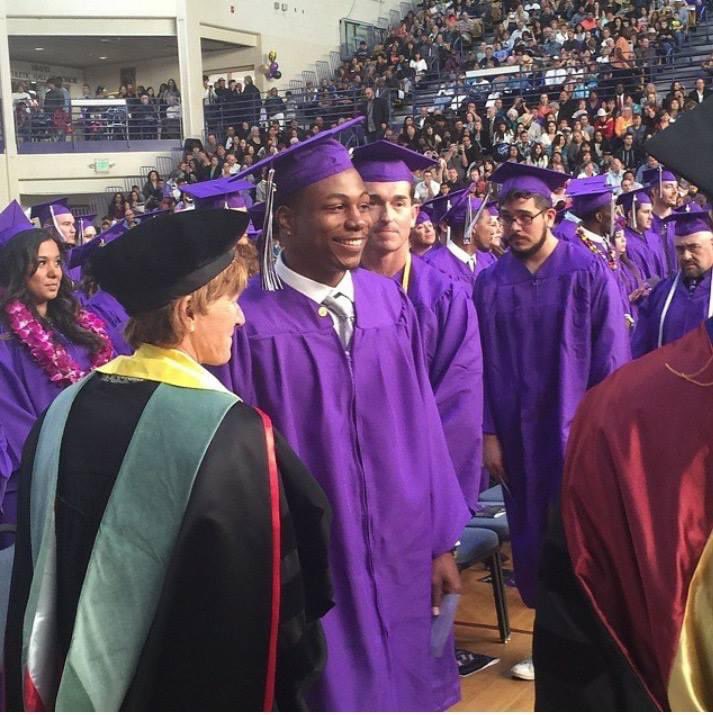
Keenan Anderson accepting a diploma. Anderson died in LAPD custody after police officers struggled with him, tasing him multiple times on January 2023 (Source: Dominique Anderson)
LOS ANGELES — Los Angeles City Controller Mejia recently released the results of their assessment of the Los Angeles Police Department (LAPD)’s Mental Evaluation Unit (MEU), the unit designed to respond to situations involving mental health crises. The assessment claims that LAPD does not give their units necessary tools, receives minimal mental health training and the unit infrequently attempts to de-escalate when called. LAPD shoots people with mental illness at a higher rate than the national average.
Make a one-time donation
Make a monthly donation
Make a yearly donation
Choose an amount
Or enter a custom amount
Your contribution is appreciated. Your one-time contribution is appreciated. Donations are always welcome, there is no paywall.
Your contribution is appreciated. Your one-time contribution is appreciated. Donations are always welcome, there is no paywall.
Your contribution is appreciated. Your one-time contribution is appreciated. Donations are always welcome, there is no paywall.
DonateDonate monthlyDonate yearlyThis article has been updated with comment from Deputy Chief Alan Hamilton of the LAPD
According to the LAPD, MEU’s mission is to reduce the potential for violence during police contacts with people experiencing mental illness and find additional mental health services available when they make contact. The Controller assessment focused on LAPD MEU’s Systemwide Mental Assessment Response Team (SMART) units, co-response teams of armed LAPD officers and LA County Department of Mental Health (DMH) clinicians. That assessment focused on LAPD data between 2020-2022, and looked at MEU’s use of force incidents between 2021 to 2024.
LAPD officer-involved shootings of people with mental health crises happen at a significantly higher rate than the national average. Nationwide, 20% of the victims of officer-involved shootings showed signs of mental illness. In Los Angeles, 41% of LAPD officer-involved shootings in 2021 involved people in mental health crisis; 35% of LAPD officer-involved shootings in 2022 and 2023 involved people in mental health crisis.
The City Controller’s office says their assessment was done in response to the January 2023 killings of three men experiencing mental crises in two days. Keenan Anderson died in a hospital after LAPD tased him multiple times on January 3. Oscar Leon Sanchez was fatally shot by LAPD officers on January 3. Takar Smith was fatally shot by LAPD officers on January 2.
Deputy Chief Alan Hamilton heads up LAPD’s Detective Bureau, which oversees the MEU. He said that “we set the standard for investigations department wide. MEU is folded into that.” Hamilton questioned some of the methodology on the Controller’s Office assessment; they were not clear about methodology and in some cases may have lacked data necessary for a full audit. “They conducted their own assesment under their own rules and their own guidelines,” Hamilton told Ten Four.
Controller Mejia said in a statement, “I took Office in the middle of December 2022 and in the first week of January 2023, during a 48-hour span, LAPD killed three men who had a history of mental health conditions or appeared to be in mental crisis. This was one of the reasons why we launched this assessment.”
Body Worn Video of the death of Keenan Anderson
Anderson was asking for help from officers at several moments during a traffic stop in 2023. Several times, he told officers that someone was attempting to kill him. Anderson at times said he was convinced that officers responding were not in fact LAPD officers at all. No mental health response team was requested at any point during the stop that eventually ended in Anderson’s death. Anderson began to flee the officers.
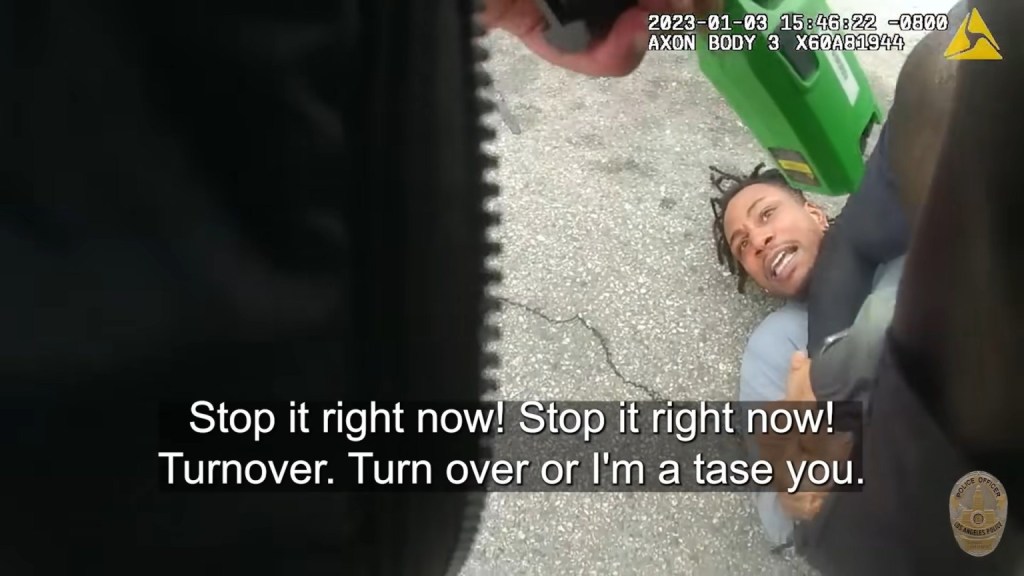
A still from body-worn video of the death of Keenan Anderson (Source: LAPD)
In a body-worn video provided by LAPD, Anderson’s voice was hoarse and fearful, as he struggled to say “they’re trying to George Floyd me.” Anderson turned over, as an officer threatened to deploy a taser on Anderson. The officer then tased Anderson repeatedly, telling him to “stop resisting,” long after Anderson was handcuffed.
Then-LAPD Chief Moore later said during a press conference that officers attempted to tase Anderson six times — two didn’t appear to be effective, officers tased Anderson four more times over 33 seconds. No mental health response team was requested during the stop that eventually ended in Anderson’s death.
Hamilton questioned how MEU or a hypothetical unarmed response would have changed the outcome. Hamilton said to Ten Four “How is MEU gonna slide in there and have an effect? [Mejia] brings up that name; you’re gonna argue that he had mental health issues? I’m gonna go with the cocaine intoxication.”
Anderson’s family is currently in the process of suing; they’re asking for more than $100 million. The Los Angeles County Coroner’s Office released the cause and manner of death of Keenan Anderson later in 2023. In a press release, the office announced Anderson’s cause of death as “effects of cardiomyopathy (enlarged heart) and cocaine use (death determined hours after restraint and conducted energy device [CED] use),” the statement said.
Body Worn Video of the death of Oscar León Sanchez
Oscar León was shot and killed by LAPD officers on January 3. Both León’s family members and LAPD say that he’d been experiencing a mental health crisis when he was fatally shot by LAPD officers. León had been throwing objects at vehicles while walking down the street, and several drivers called 911.
Sanchez then left the area, and walked to a vacant home he’d been living in. For several minutes, officers asked or commanded León to meet them. Bodycam footage is hidden behind a ballistic shield in one view; in others, it’s difficult to see Sanchez. Sanchez appears to have been holding the top portion of an electric scooter. Officers fired upon Sanchez with both a handgun and a less-lethal bullet, killing him.
In November 2023, LAPD’s Board of Police Commissioners found the January killing of Smith was “not justified,” as the responding officers were not facing an imminent threat when they shot him in the throes of his mental health crisis. Smith’s wife had called LAPD and informed him of Smith’s schizophrenia; Smith hadn’t been taking his medication according to Smith’s wife. She pleaded with them to not kill her husband on the phone and when LAPD officers did respond, fatally shot him.
Body Worn Video of the death of Takar Smith
LAPD’s then-Chief of Police, Michel Moore, said at a press conference he was “deeply concerned” about each of the killings and made clear that MEU teams weren’t deployed. “I’m being very clear about my dissatisfaction with what I believe were points of information regarding [Smith’s] mental health,” and pointed to the fact that no one called the MEU.
The Controller’s office assessment says that SMART’s ability to improve outcomes is “extremely limited because they are secondary responders to armed patrol units.” SMART units are not allowed to interact with subjects until patrol units have given their approval. SMART’s ability to improve outcomes is “extremely limited because they are often dispatched to incident types where mental health clinicians cannot directly intervene,” according to the Controller’s office.
SMART’s ability to improve outcomes is extremely limited because they are often dispatched to incident types where mental health clinicians cannot directly intervene. LAPD does direct SMART units to be dispatched alongside patrol when mental health related calls also involve armed or violent subjects.
The MEU has existed since 1992. As far back as 2016, LAPD employees have called for expanding the program. In 2016, then-head of the MEU Lieutenant Brian Bixler told reporters “I wish that people didn’t have to call 911 when their loved one was in a mental health crisis. I wish it was two clinicians that could go out there and deal with it before it gets to the point of violence.” And in 2020, Bixler called for expansion of the program’s resources, saying “I don’t know if we need more units but I know we do need more resources for the community to access when it’s not a 911 call.”
Hamilton told Ten Four that there are about 55 officers working within MEU. Most of the time, there are three of them working per shift throughout the city. “When we are fat on weekends, we are maybe going four or five citywide.”
Current Council President Marqueece Harris-Dawson then-Council President Paul Krekorian and City council members, stating on social media “The families of Keenan Anderson, Oscar Leon, and Takar Smith deserved full, long lives together and access to appropriate crisis response. But since that has been taken away, they deserve justice.”
Several members of the city council made similar statements at the time, and eventually an at-the-time dead bill to pilot an unarmed police response separate from the SMART teams. Called Unarmed Model of Crisis Response (UMCR), the program launched later in 2023 and staffed two teams of unarmed, non-law-enforcement responders like emergency medical technicians and therapists.
The Controller recommended continuing to support UMCR’s multi-year pilot, and to consider expanding it if the pilot demonstrates successful alternatives. The UMCR is, however, a limited pilot program.
In response to the report, City Councilmember Nithya Raman said in a statement that the report “underscores that we urgently need a true city-wide unarmed crisis response program, one that allows for many more mental health calls to be handled by trained clinicians and social workers.” She continued, saying that programs like UMCR “is the holistic approach to public safety we need for a safer city.”
Other city officials told Ten Four that the program will never fully supplant SMART teams or LAPD in general. The teams are run by local nonprofits, are only currently utilized in three divisions and some in law enforcement say that it will be difficult to staff UMCR positions without armed law enforcement to protect them. One city official shared that they were concerned with a lack of oversight on those local nonprofits.
Hamilton told Ten Four that unarmed response units would be unable to assist in situations that SMART was deployed. Clinicians would not be able to be safe in escalating conflict or with dangerous contacts, he told Ten Four. Hamilton expressed that sending unarmed clinicians could result in further violence; he said “you think [officer involved shootings] are bad now? You want them to go up another 50%? Try sending SMART teams alone.”
When asked about unarmed response teams, Hamilton pointed to CIRCLE’s limited involvement beyond providing food, water and clothing. He called them “SWaT,” and explaining it meant “Snacks, Water and Treats.” Hamilton further said that “I don’t think it’s fair to say that they’re doing the same thing you’re gonna get from an MEU unit. That’s outlandishly inaccurate. They’re not providing the same level of service.”
In response to the assessment, Mayor Karen Bass said that she’d “worked to take a comprehensive approach to public safety. Together with the City Council, we increased investments in civilian crisis response models, like Crisis and Incident Response Through Community-Led Engagement (CIRCLE) and [UMCR], to effectively divert calls for service involving Angelenos in crisis to trained mental health teams.”
CIRCLE is an unarmed response program which focuses on the unhoused in the city. Bass’ team calls the program, which began in 2022, “proven.” It focuses on well-being checks, lack of clothing, noise disturbances, person on a substance, and loitering. CIRCLE teams are equipped with vehicles and supplies like water, snacks, clothing, and opioid overdose reversal medication Narcan. In 2024, the program began to include areas within Los Angeles’ Westside neighborhoods.
Bass pointed to civilian response on nearly 25,000 incidents in the most recent fiscal year. Her statement said that programs like CIRCLE and UMCR “have a vital role to play, and I will be working with the Controller and LAPD Chief McDonnell on reviewing,” the Controller’s recommendations. She continued, saying that her office “will take stock of additional needs, like building out a robust mental health clinician workforce in the region.”
On May 2, 2024, LAPD officers responded to calls for assistance for Yong Yang, who was experiencing a mental health crisis. Less than 10 seconds after officers entered, an LAPD officer shot Yong Yang three times. Yang’s family had earlier called the Los Angeles County Department of Mental Health clinician who arrived at the apartment and conducted a crisis evaluation of Yong Yang. He was there less than a minute according to the Yang family.
According to the LAPD, officers contacted MEU and were informed that Yong Yang had five previous contacts with the unit. The unit then dispatched members of a mental health response team called SMART; they never made contact with Yong Yang.
Echoing previous complaints by the Controller’s office about LAPD cooperating with them and complaints regarding the Controller’s Office by LAPD, the assessment says that requests for information regarding MEU’s impact on uses of force. “We found that the LAPD did not have any of the requested documentation,” according to the report. SMART’s performance is only analyzed by LAPD in one metric, according to the assessment: “how quickly SMART relieves patrol officers from on-scene duties.” Because of this, LAPD provided “no metrics to show how SMART achieves MEU’s goals or contributes to de-escalating high-risk mental health calls for service, there is no way to determine SMART’s impact on mitigating use of force and deadly outcomes.”
Hamilton told Ten Four that LAPD did cooperate as much as was possible with the Controller’s assessment, but that they were unable by law to provide mental health data due to HIPAA and other health privacy laws. He said “you’re assessing the feasibility of our deployment,” he continued “how are you engaging outcomes without the information you’d use to gauge that outcome. They don’t have access to any medical information.
Hamilton assured Ten Four that the department did what it could to give as much information as they could, telling Ten Four “we cooperated with the information we could provide. We didn’t play any games. We didn’t obfuscate anything.”
Mejia’s office said in their report that while the general population of the City is 48% Hispanic; 9% Black; 41% White; 2% Other that Black people were more often contacted by MEU. 34% of the calls involved Hispanic people; 29% Black; and 29% White people.
Hamilton told Ten Four that “we respond when people call.” He said that it is possible that “people are more likely to call in a majority white community for mental services when people are mentally impaired.”
According to the assessment, SMART units are primarily used to complete involuntary 5150 mental health holds. From 2020 through 2022, 84% of incidents handled by SMART were for 5150 holds. 86% of calls handled by SMART in 2023 resulted in a 5150 hold application.
The assessment watched instructors within Mental Health Intervention Training (MHIT), and says that the Controller’s Office found “serious concerns,” about “fundamental expectations of officers who encounter people experiencing mental health conditions,” as well as concerns about “the broad discretion afforded to officers in completing 5150 hold applications.”
Instructors devoted a large portion of training to how to write and complete a 5150 hold; according to the assessment. “The gravity of subjecting someone to an involuntary detention was seemingly dismissed,” during the instruction according to the assessment. “One lecturer described involuntary detention as ‘you’re not taking them to get locked down for life, you’re trying to provide them with a resource to get help.’” one instructor is quoted.
Another quote within the assessment downplayed clinicians while expanding upon LAPD’s ability to do mental health holds, reading “Once you graduate from the academy, you can complete a hold application the first day out [as an officer]. DMH clinicians have a different process – BA, MA, complete 3000+ hours of field training before they are even able to complete a hold application on their own. What magic in the Academy do they give us that we can just do this? The answer is the laws. It’s kind of funny that clinicians have to go through this whole regimen of training that we get to skirt by.”
MEU officers, including SMART officers, do not receive specialized training according to the Controller’s Office. They receive MHIT, which is “department-wide, one-time, and only covers basic principles – the same training that may be expected of any rookie LAPD officer.” The Controller’s Office continued, saying “as a one-time training, MHIT does not align with best practices in law enforcement-based crisis intervention training.”
Within the assessment’s quotes, a trainee said “Realistically, for liability reasons, I’m not safety planning, I’m doing a hold. And let the doctors handle it. I want to cover our ass, because someone is always going to find something I didn’t do. We can write the hold app easily.”
In response to the trainee’s declaration, another trainer who works as a SMART officer stated, “We’re giving you best practices. It’s your choice what you want to do when you get out there.”
According to the Controller’s Office, LAPD’s policy does not provide much specific direction for interacting with mental illness. The LAPD’s policy is currently a vague statement, lacking definition and clear guidance for officer conduct. Not every LAPD officer has participated in the LAPD’s Mental Health Intervention Training. The assessment recommends including specifics which include: “de-escalation techniques, how to address specific indicators of mental health concerns, and promoting a higher standard of accountability for officers.”
Only 6% of MEU Incident Reports which were randomly sampled and reviewed by the Controller describe de-escalation attempts. 61% do not describe attempts to de-escalate, and 33% were for incidents that did not need de-escalation. The majority of MEU incidents reviewed involve patrol officers, not SMART officers.
The Controller’s office said that in almost all scenarios, LAPD’s policy mandates that people with mental illness are handcuffed according to the Controller. It is LAPD practice to handcuff a person during a mental health call, which the Controller called “an act that can be escalating and triggering,” before SMART units are able to conduct a mental health assessment.
In a statement, Controller Mejia said “Currently, the primary response that exists for mental health emergencies is the LAPD’s Mental Evaluation Unit’s SMART teams. MEU’s own stated mission is to prevent unnecessary incarceration and hospitalization and reduce violence – however, my Office’s assessment of LAPD MEU found that LAPD does little to prove MEU or SMART accomplish any of this.”
Hamilton closed out a telephone interview with Ten Four, saying that “I’ll tell you what: if we have a two percent failure rate, we have a 98 percent success rate.”
 LA Ten Four
Leave a comment