By Sean Beckner-Carmitchel
Protests After No Kings Greeted By Horses Protecting Federal Detention Facility
LOS ANGELES — A crowd of hundreds gathered in the late afternoon Saturday outside the Metro Detention Center in downtown Los Angeles, turning what began as a nearly universally peaceful rally into officers carrying dozens of batons, “less lethal” munitions and wooden swords held by Los Angeles Police Department (LAPD) officers.
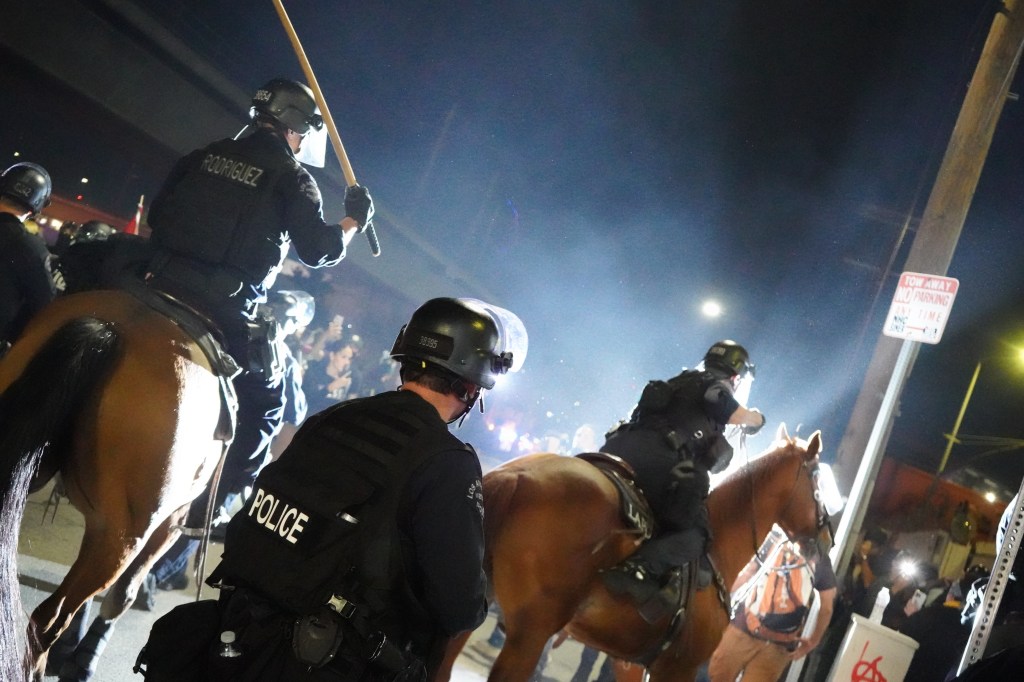
LAPD officers clear protesters, carrying large sticks and batons (Sean Beckner-Carmitchel)
Make a one-time donation
Make a monthly donation
Make a yearly donation
Choose an amount
Or enter a custom amount
Your contribution is appreciated. Your one-time contribution is appreciated. Donations are always welcome, there is no paywall.
Your contribution is appreciated. Your one-time contribution is appreciated. Donations are always welcome, there is no paywall.
Your contribution is appreciated. Your one-time contribution is appreciated. Donations are always welcome, there is no paywall.
DonateDonate monthlyDonate yearlyThe protest came after Los Angeles’ portion of nationwide “No Kings Day” movement protests. Thousands attended, and marched through downtown Los Angeles after several hours of rallying. At the “No Kings Day,” rally in Los Angeles “No Kings” organizer Hunter Dunn told Ten Four during the rally that the Los Angeles portion were there for a “united front against the abuse of office by Donald Trump and the billionaires that puppeteer him.”
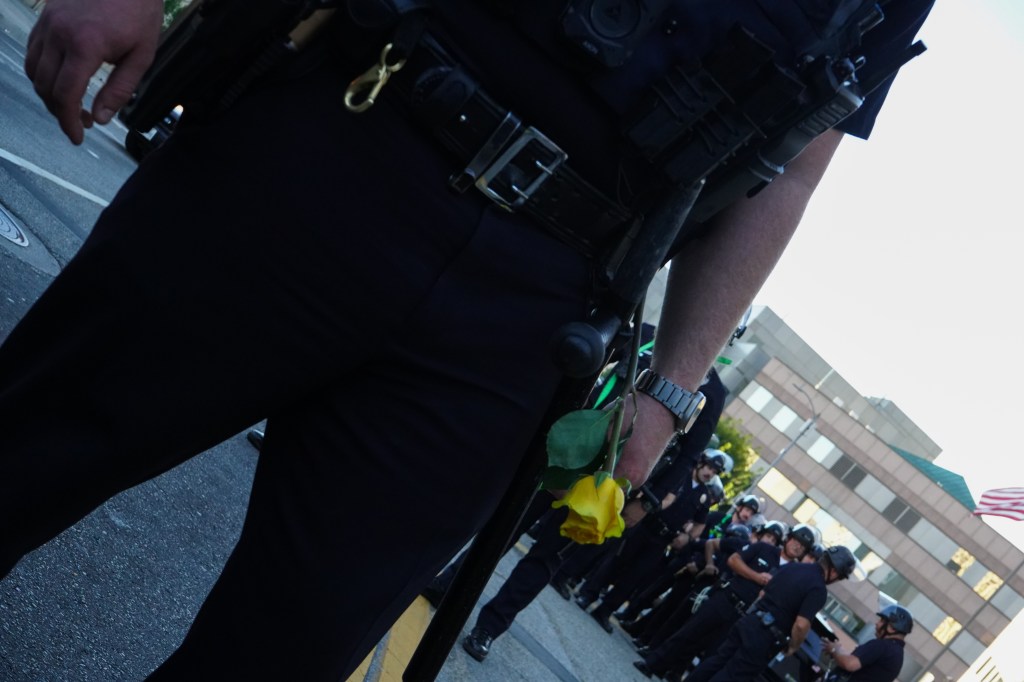
An offier places a flower given to him by protesters in front of his baton in front of Metro Detention Center (Sean Beckner-Carmitchel)
As daylight faded, the protestors drew nearer to the facility’s perimeter. Lines of LAPD officers stood guard near the entrance. Protesters stopped several feet away, shouting at the officers and holding their phones up to record. Some protesters began to sit in the street as more LAPD officers arrived.
The detention center has become a symbolic target for protesters. The center houses federal immigrant detainees, and has become the site of nightly protests which often result in arrests by LAPD or Department of Homeland Security (DHS). The facility has come under scrutiny for its treatment of those housed there, and a lawsuit by dozens of pro-immigrant organizations, unions representing farmworkers and nearby cities including Los Angeles.
Protests in front of the Metro Detention Center have often been a beacon for questioned tactics by various law enforcement agencies and are mentioned dozens of times in lawsuits by the American Civil Liberties Union Southern California (ACLU SoCal) against LAPD, Los Angeles Sheriff’s Department (LASD) and Department of Homeland Security (DHS).
(note: Sean Beckner-Carmitchel, the author of this piece, is a plaintiff in the lawsuit against DHS and has submitted declarations in the lawsuits against LAPD)
In September, dozens of LAPD officers from Hollenbeck division pushed, shoved and batoned protesters as well as journalists while wearing a pin featuring Speedy Gonzales – a Looney Tunes character often accused of being racist against Mexican people. For months, protesters who have assembled at the detention center nightly have accused LAPD of overly aggressive tactics and arrests.
Dozens of those at the protest at Metro Detention Center were small children. Fruteros and other food vendors began to arrive. Several faith leaders stood near the front, urging de-escalation between officers and protesters. Despite the heavy law-enforcement presence, the atmosphere remained peaceful; chants and occasional dance breaks traded among participants.
Throughout the protests, behind dozens of LAPD vehicles and officers a contingent of DHS officers could be seen behind a fence protecting the Metro Detention Center.
One protester was hit by an LAPD vehicle driving through the protest area. The vehicle arrived on Alameda and Commercial, and an officer got out telling them they needed to move because they were there responding to an “emergency.” Protesters refused, and the vehicle hit the demonstrator. Street medics treated the protester, and the protester later returned to the site after receiving medical attention. “They can’t stop me,” the protester told Ten Four.
Tensions began to grow as the crowd edged closer to the detention center’s entrance and police began announcing an order to disperse via loudspeaker just before 7pm. LAPD issued a dispersal order for the block of Alameda Street between Aliso and Temple Streets, and warned that those remaining could be subject to arrest or other harm done by “less lethal” munitions.
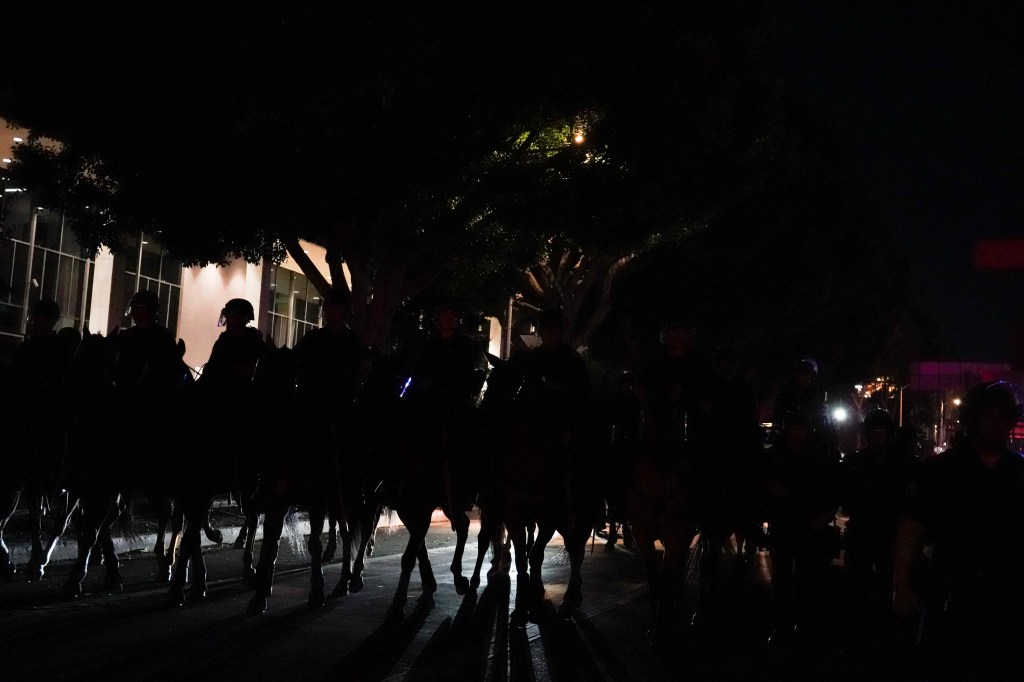
LAPD horse-mounted officers begin to move in towards protesters in front of Metro Detention Center (Sean Beckner-Carmitchel)
About 30 minutes later, most of the protesters began to attempt to go to nearby Plaza Olvera. When they began to walk up, they were met by a large contingent of officers on horseback carrying bokkens and officers on foot carrying batons. A bokken is a wooden sword, often carried by officers on horseback, used for hitting those that won’t comply with their orders.
When the horses arrived, chaos ensued. Protesters went in nearly every direction. Several screamed in fear, attempting to run away. Officers gave conflicting orders to protesters, in several cases forcing them into an area where they were then batoned or shot by “less lethal” munitions by other officers.
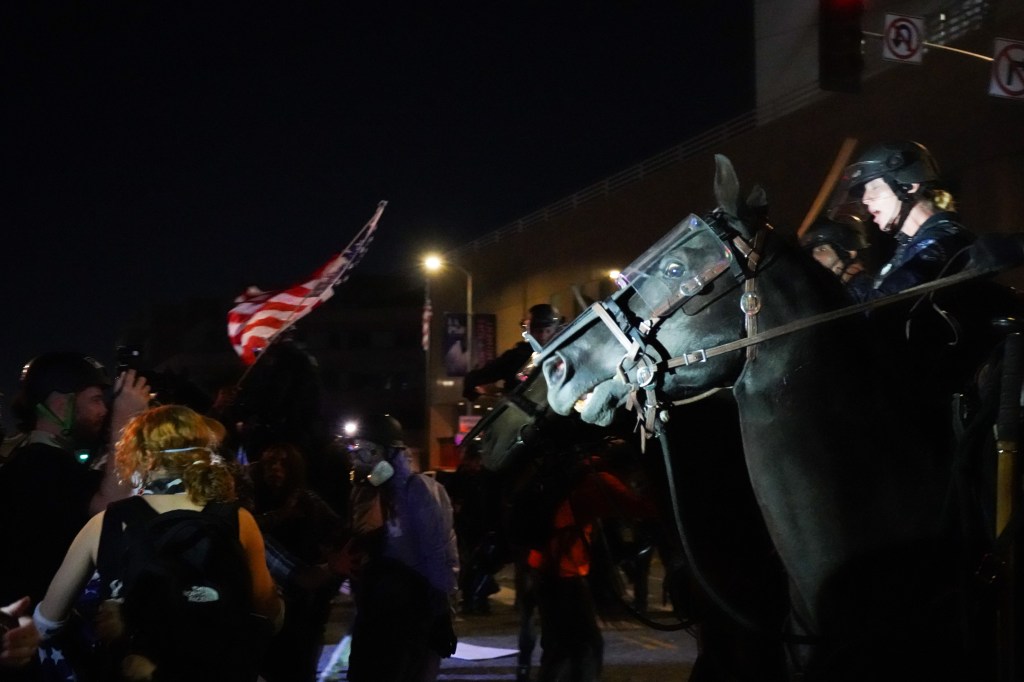
LAPD horse mounted units charge into protesters, as officers riding them slash and hit protesters with bokken (Sean Beckner-Carmitchel)
Horse mounted units continued down Commercial, pushing the majority of the protesters down Commercial street. Horse mounted officers continued to scream “leave the area.” One protester could be heard yelling “animal abuse!” Several horses appeared to get turned around, doing spins while whipping several protesters in the face with their tails.
“Get on your own side,” several protesters yelled at several LAPD officers who were in the middle of the crowd on Alameda. Dozens of feet away from the line, they began hitting protesters with batons. They then returned to the police line.
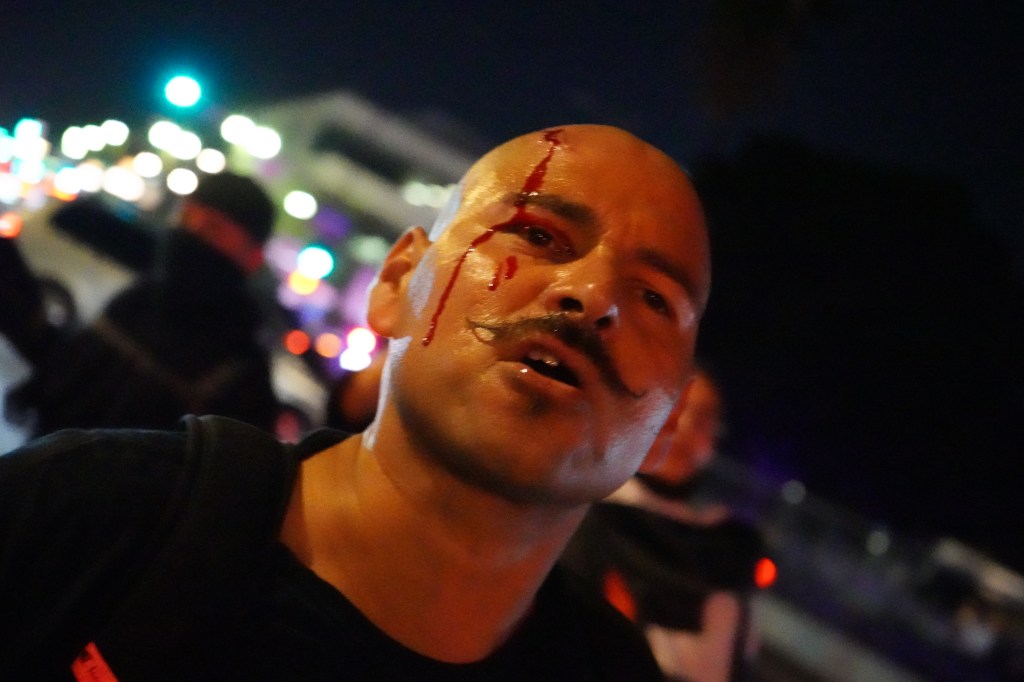
A bicyclist shouts at officers after they pushed him off, and blood streams down his face (Sean Beckner-Carmitchel)
One man who was on his bicycle in between several lines of officers was roughly thrown to the ground, hitting his face on the pavement. As blood trickled from his forehead down his face, he verbally confronted officers.
After the rush, several journalists, including Ten Four were told by LAPD officers “we don’t want you to get caught in the rush.” They were then told that they must “remain far behind, you’re gonna be behind officers and you’re gonna get hurt. I don’t want you to get hurt.” Pictures on social media show dozens of injuries to demonstrators and media. Welts to the face and head caused by bokken were observed by Ten Four. “Less lethal” projectiles caused bruises and lacerations to several protesters as well.
Officers roughly attempted to throw a photographer, and hit him with at least two pepper ball munitions before that which left marks on a bag which was resting near his back. Southern California News Group reporter Ryanne Mena was hit shoved alongside several others. She told Ten Four that “what felt like a pole-like object slammed into my left arm.” Mena continued, saying she witnessed an officer “violently grab [the photographer], even though he was wearing a press credential and had a camera out – a clear member of the media.”
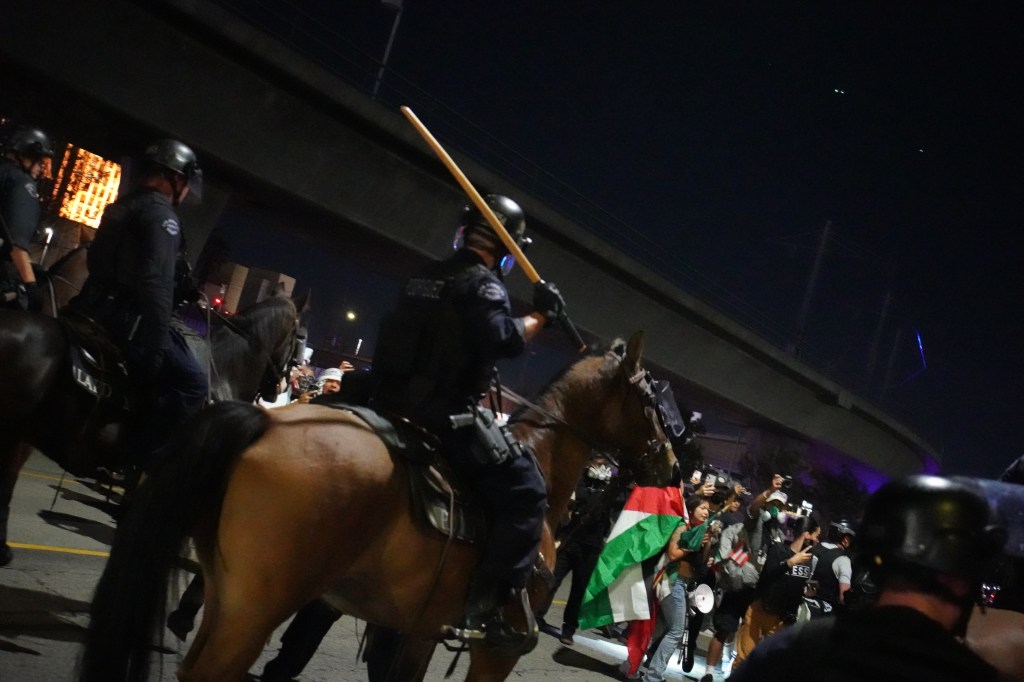
Protesters cower as horse mounted units continue to push into them near Metro Detention Center (Sean Beckner-Carmitchel)
LAPD continued to march protesters down Commercial into a dark corner near Chinatown. Officers continued to shoot “less lethal” munitions and took swings with bokken at demonstrators. They briefly surrounded the protesters, and told them they could not leave but after several minutes sent the group towards Chinatown. Many in the group reassembled at a Chevron gas station in Chinatown. There, they were again told by officers that the assembly was unlawful.
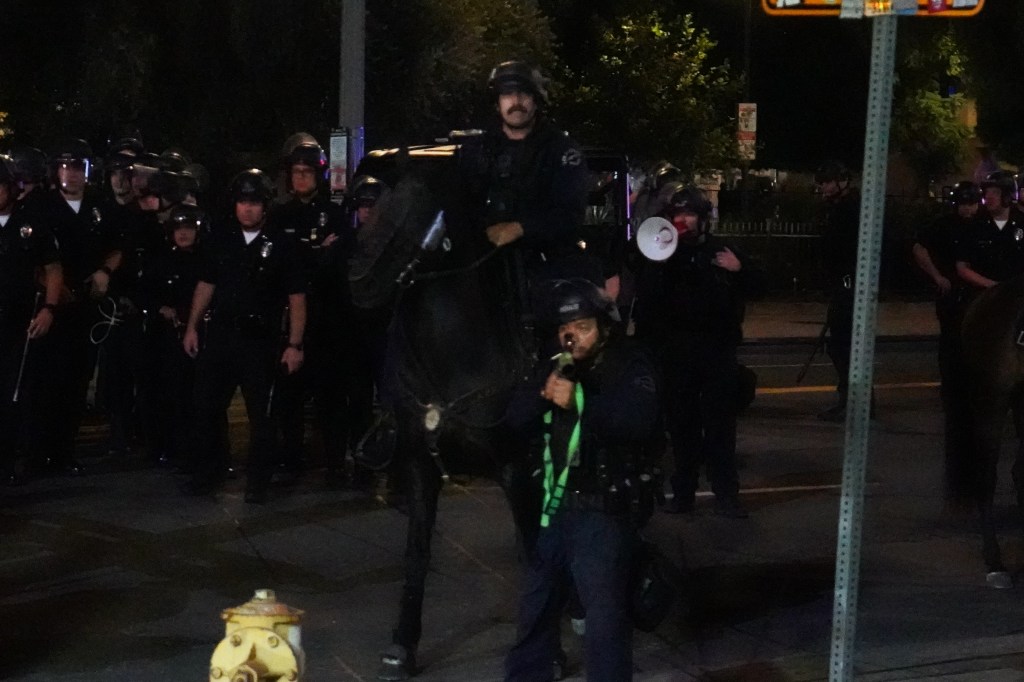
An LAPD officer points a less lethal weapon near a press scrum in Chinatown (Sean Beckner-Carmitchel)
As a much smaller group assembled at the Chevron station, several were hit by “less lethal” munitions. Though they again appeared to be mostly nonviolent – by Ten Four’s viewing perspective entirely – they were hit by bokken, batons and shot by “less lethal” munitions. One man appeared to have been hit in the shoulder or neck by a kinetic projectile from several feet away.
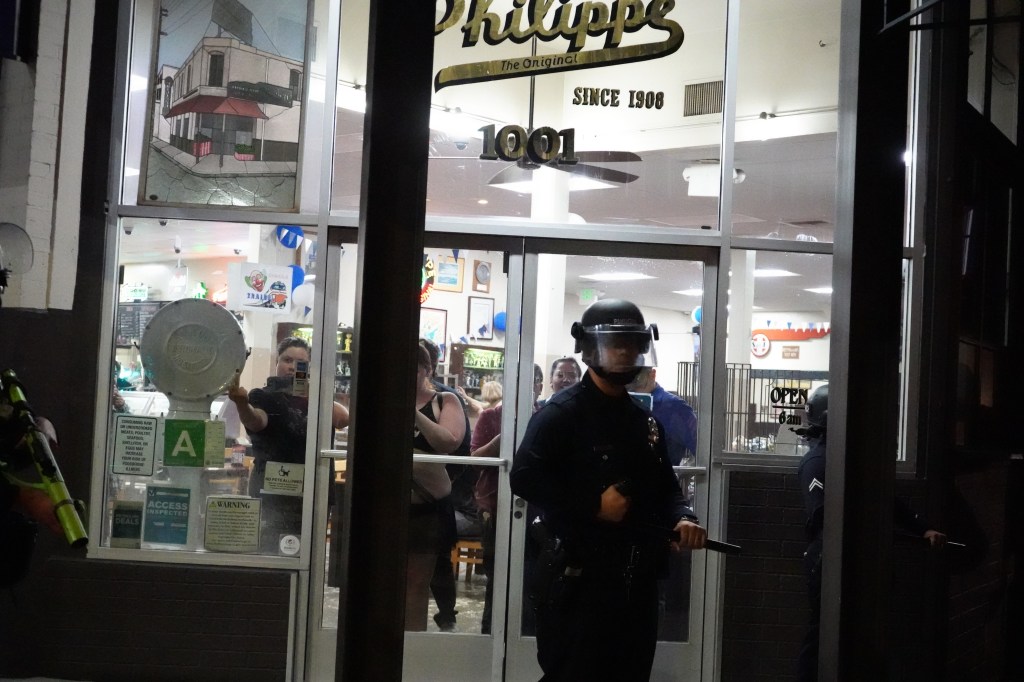
Protesters make gestures at LAPD Officers from Philippe The Original in Chinatown (Sean Beckner-Carmitchel)
As officers continued to move protesters, local French Dip legend Philippe The Original allowed several demonstrators in its doors. They flipped off officers, watching others continue to get moved down the street.
As LA Taco reporter Lexis Olivier-Ray was backing away from “less lethal” munitions being fired near his direction, Film The Police LA’s William Gude shouted “you’re shooting at press. An officer replied “that’s fake press.”
The same protester who had been hit by an LAPD vehicle earlier in the day was hit by several “less lethal” projectiles near the Chevron station.
LAPD Officers could be heard yelling directions at others who were armed with “less lethal weapons.” One man, who was wearing a keffiyeh and sitting on top of a dumpster near the Chevron station, was pointed out by an officer. He then asked that officer to “watch him.”
The officers then began to return to Metro Detention Center, followed by protesters yelling at them. Many began to chant “shame,” repeatedly. When officers returned near the detention center, another charge of officers cut off about a dozen demonstrators who were able to sneak onto a green patch near the 101 freeway. Those that didn’t flee onto the freeway patch were detained for several minutes; press who were there were told that they must declare who they were working for. Some (including Ten Four) refused to answer and were forced to remain in the kettle for several more minutes. Officers then arrested protesters.
As the night closed, LAPD officers again called unlawful assembly at the Metro Detention Center. Several were chased down and arrested. One man was arrested for remaining in the street; footage clearly shows the man had been walking in the crosswalk while the lights were flashing a “walk” sign.
LAPD was asked by Ten Four why LAPD blocked off the street in front of the Metro Detention Center. The area had been blocked off long before any protesters had arrived, and many in the crowd told Ten Four that LAPD’s policing in front of the detention center is effectively cooperating and providing cover for the federal immigration agents there. LAPD’s Media Relations Division told Ten Four that “The area on Alameda near the Metropolitan Detention Center was utilized as a field command post for LAPD resources. Staging in the area provided adequate and timely response to the area.”
Allegations of excessive force by the LAPD are nothing new, particularly allegations by demonstrators. LAPD has faced decades of scrutiny over its use of excessive force against protesters, dating back even beyond violent suppression of anti–Vietnam War and civil rights demonstrations in the 1960s. High-profile incidents, including the 2007 MacArthur Park May Day melee and the 2020 George Floyd protests, drew widespread criticism and lawsuits alleging indiscriminate force against peaceful demonstrators.
The lawsuit against LAPD by the Los Angeles Press Club has been particularly contentious; a request for a temporary restraining order was initially denied. In July, a preliminary injunction protecting journalists from using “less lethal” munitions and being detained was granted and U.S. District Judge Hernán D. Vera granted a preliminary injunction barring LAPD from using kinetic projectiles as well as batons against journalists.
Just days before the “No Kings” protest on Saturday, Los Angeles’ City Attorney Hydee Feldstein-Soto filed for a stay on the preliminary injunction arguing that the restrictions were overly broad. Judge Vera denied the request, saying that the city’s arguments had already been “largely mirroring those raised and addressed,” in the previous hearings.
In addition to Feldstein Soto’s request for a temporary stay, Soto’s office has filed an appeal of the injunction with the U.S. 9th Circuit Court of Appeals. Tentatively, a hearing is set for mid-November. In a statement, Councilmember Eunisses Hernandez said that “Journalism is under attack in this country — from the Trump Administration’s revocation of press access to the Pentagon to corporate consolidation of local newsrooms.” Hernandez, who is an author of the directive which was unanimously passed, continued “the answer cannot be for Los Angeles to join that assault by undermining court-ordered protections for journalists.”
Feldstein-Soto’s office has requested $250,000 to hire an outside law firm to defend the city against the suit brought by the Los Angeles Press Club. The contract would be for three years of legal work, and names Best Best & Krieger as the firm.
Since the protests have begun, the Los Angeles Board of Police Commissioners has been largely quiet regarding allegations of excessive force. The Commission is the body which is responsible for overseeing the department, and its members are appointed by the Mayor.
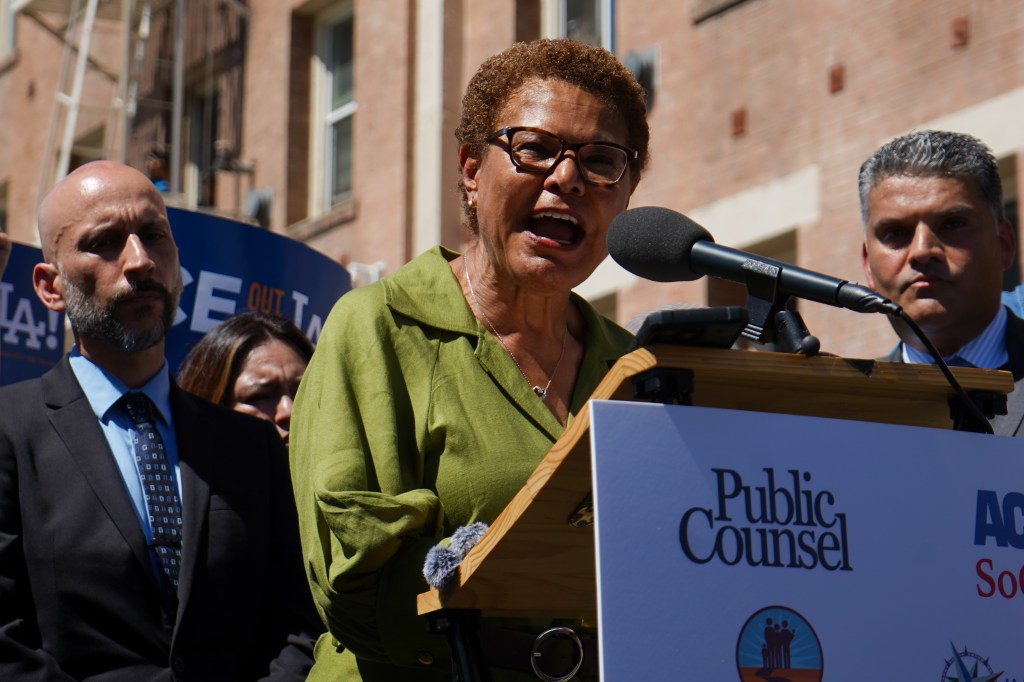
Mayor Karen Bass at a press conference denouncing federal immigration crackdowns in Koreatown in August (Sean Beckner-Carmitchel)
As Los Angeles Mayor Karen Bass has taken to calling the federal immigration raids “illegal,” and “unconstitutional.” Even while the city pours dwindling coffers into overtime protecting federal agents at a federal facility, the lawsuits alleging excessive force have been increasing. She has not commented publicly on allegations that LAPD has been violating constitutional rights, even as the city has poured resources into fighting lawsuits.
Adam Rose, who heads the Press Rights Committee for the Los Angeles Press Club, told Ten Four that “Mayor Bass has been an elected official representing or governing the people of Los Angeles for over 20 years. In that period LAPD has brutalized journalists over 100 times and cost taxpayers millions in settlements and judgments. Now as mayor the last few years this is her chosen chief and her police commission.” Referring to Bass being absent and in Ghana during the start of deadly wildfires earlier this year, Rose said “It’s her LAPD. She has said nothing. She has been more absent on this issue than when she was out of the country during the fires.”
It’s her LAPD. She has said nothing. She has been more absent on this issue than when she was out of the country during the fires.”
-Adam Rose
At a Monday press conference, Bass joined Congressman Robert Garcia, members of the L.A. City Council, and immigrant rights groups to call for a Congressional investigation into what her office called the “unlawful and unconstitutional abduction, detainment, and alleged abuse of U.S. citizens and immigrants by federal agents without a judicial warrant or probable cause.” There, she said “I will always stand up to protect Los Angeles. Reports of Angelenos – U.S. citizens – being tased, dragged, and unlawfully detained should make us all concerned,” said Mayor Karen Bass.
Bass has been clear regarding her criticism of federal detentions and the actions of federal policing agencies, saying at the press conference“I’m calling for an immediate Congressional investigation into these egregious injustices, and I thank Congressman Garcia for his support. This is not just an assault on the people of Los Angeles – this is an assault on every person, in every city in this country.”
Over the course of the protests in Downtown Los Angeles, 14 people were arrested; two of them were juveniles. LAPD did not respond to inquiries regarding any potential charges they may be facing.
LAPD declined to comment specifically on individual issues, saying that “At this time, I don’t have any information to provide specifically regarding journalists. Any reported uses of force, including the deployment of less-lethal munitions, are subject to review under established Department protocols. The LAPD continually evaluates its crowd control tactics and training to ensure that the rights of the public and the press are protected while maintaining public safety.”
 LA Ten Four
Leave a comment